Change Is Hard

…but change is certain.


6 Comments

Wish they taught history like this when we were growing up.

The 'epicenter' of our country, where it all began.

The ‘epicenter’ of our country, where it all began.


Did you know the birthplace of our country was not in Plymouth Massachusetts? Me either. Or if I knew I’d certainly forgotten. (Click on any picture to make it larger and more clear.)

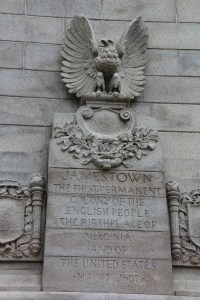
Today we visited Jamestown, where the English landed in 1607, and the location of their first successful settlement. They attempted four other settlements in years prior at other locations, but each of those failed.

Captain Smith faces the James river at what was once the front entrance to the fort.

Captain Smith faces the James river at what was once the front entrance to the fort.

Jamestown was settled in 1607 as a business venture because the English had heard there were riches to be had in America. The settlers were immediately and continually attacked by the local Indians and by the winter of 1608 were without food in brutal cold. Many died, and by the next spring less than 60 survived.
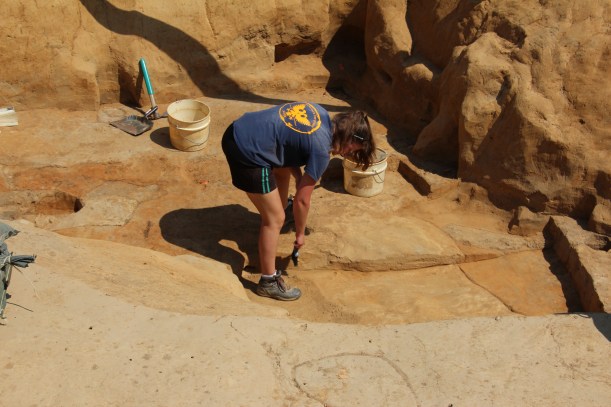
Archeologists finally found the original fort in the mid-90s after decades of attempts.  They are still digging.

Archeologists finally found the original fort in 1992 after decades of attempts. They are still digging.

This is the fort where Pocahontas and John Smith met. She did, in fact, save his life, but she did not have a romantic relationship with him, despite what Disney says. She brought food to the fort during the long winter, and ended up marrying John Rolf and moving to London where she died young, and where she is buried.
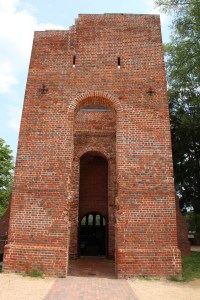
The brick tower of the church is the only original structure left and dates from the mid 17th century.

The brick tower of the church is the only original structure left and dates from the mid 17th century.

Our docent at Jamestown reminded us that if this settlement had not survived England would likely not have tried again. The area would have been settled eventually, but most likely by Spain, or possibly France. Our country would not have existed were it not for these few surviving settlers.
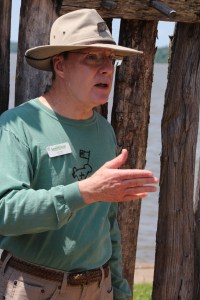
Our docent spent an hour and a half telling us about the history here.

He spent an hour and a half telling us about the history here.

Kind of makes you think doesn’t it.

Later in the day we learned the history, just up the road, of the 1781 battle at Yorktown which ended the American Revolution. The British were camped there, led by a very strong and successful Lieutenant General, Charles Cornwallis. General George Washington, in conjunction with French Allies, had far fewer troops than the British, but beat them at Yorktown, in part because they had larger artillery and cannons.
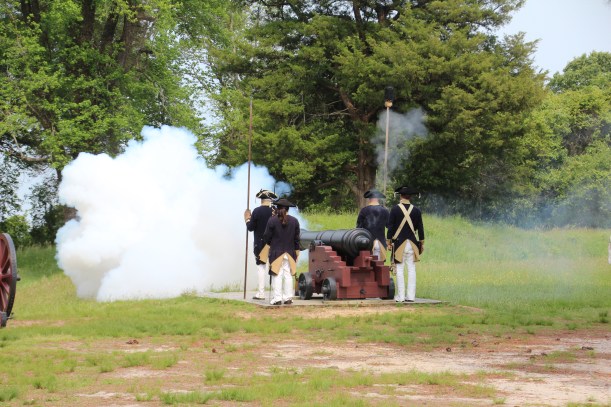
"FIRE!"

“FIRE!”

It’s a much longer and more complicated story than that, but it comes down to the fact that we had the bigger guns. We got to watch a 24 pound cannon be fired at the Yorktown Visitor Center. It was pretty impressive.

The ranger says that while the battle of Yorktown didn't end the war, nothing significant happened after, so essentially it was this surrender of the British that gave The United States independence.

The ranger says that while the battle of Yorktown didn’t end the war, nothing significant happened after, so essentially it was this surrender of the British that gave The United States independence.

Then we drove a bit to the Moore House where the terms of surrender were worked out between the British and us. It’s a pretty little house with a long lawn down to the James River. It wasn’t open when we were there but I enjoyed walking down to the river to see the view.

Where details of the British surrender were worked out.

Where details of the British surrender were worked out.

Yesterday we were in Colonial Williamsburg, and while we were there we toured a bit of the College of William and Mary. I’ve got lots of photos, and it’s going to be hard to choose which to show you.
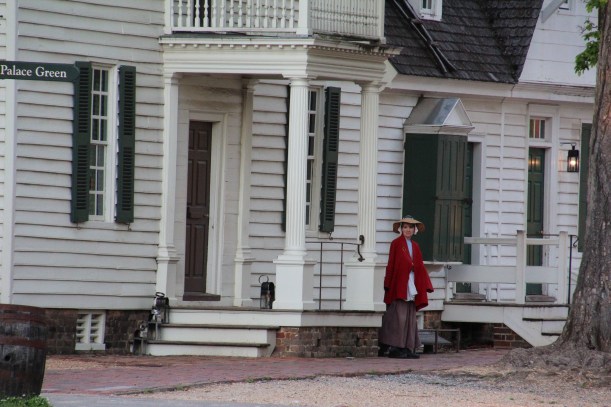
Waiting.

Waiting.

Today was Mother’s Day, and I’ve associated mockingbirds with my mom for many years. Oddly, or maybe not so oddly, there were several mockingbirds flitting about most of the day, especially at James Fort.
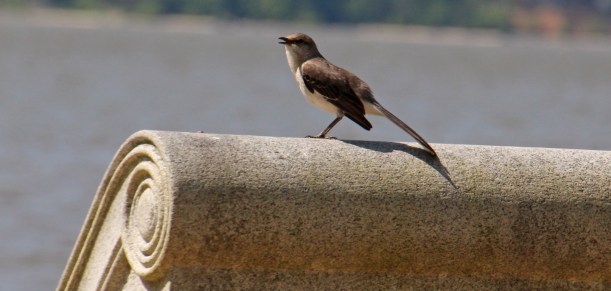
Hey mom!  We had such a pretty day today!

Hey mom! We had such a pretty day today!

Somehow I think my mom was exploring right along side of us.

Tonight we’re on the ocean at Virginia Beach. I’m listening to the ocean waves as I sort photos. Retirement is good.

Stay tuned.

The British were here.

The British were here.

7 Comments

Back in the USA – Fort Ticonderoga

It's a beautiful fort.

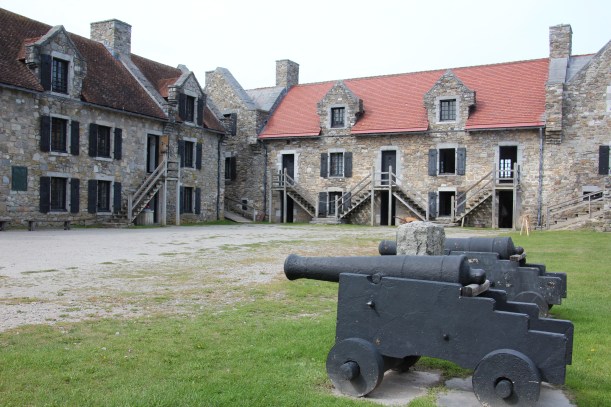
It’s a beautiful fort.


On Monday we were back in the United States. In New York State to be exact, and we had a plan. We were going to visit a fort and a set of waterfalls. We figured we could do both in one day. After all, we were becoming experts on forts this trip.

We figured wrong.

We spent the entire day at Fort Ticonderoga. We were there shortly after they opened, and we attended the last talk of the afternoon. The fort is now part of a nonprofit, with an educational mission statement. Each year they present the fort as it might have been in a particular year in history. We saw it as it was in 1755.

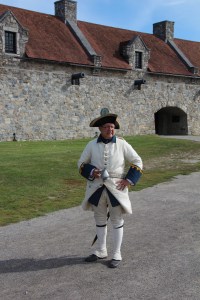
Our guide, as a resident of the fort in the mid 1700s.

Our guide, as a resident of the fort in the mid 1700s.

The stone fort sits on a peninsula of land in Lake Champlain, near the border to Vermont. It was built to control river traffic and it was held by the French first.

Watching over the lake.

Watching over the lake.

Most of the talks we heard were about the French and Indian War which started in 1754. Our guide said that it was actually a war between the British and the French…but since the British won they got to name it, and they named it the French and Indian War, though there were Native Americans fighting on both sides.

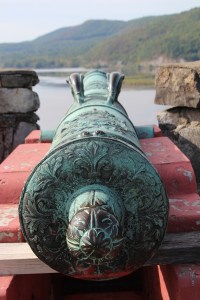
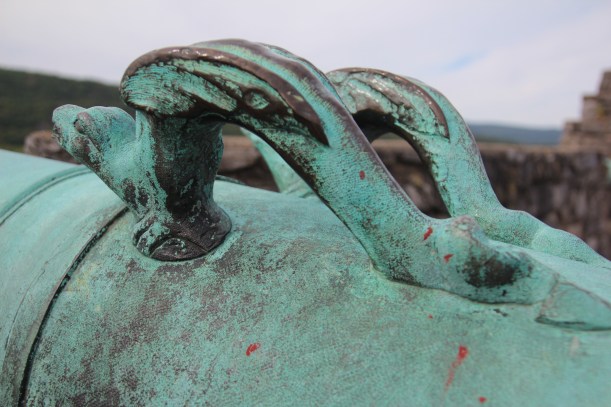
There were over 100 cannons in the fort in the mid 1700s. Over the years the fort fell into disrepair and most of it was destroyed during many conquests and losses. Today the cannons on the outside were purchased during the reconstruction of the fort in the 1950s. The blue ones are actually brass and were purchased from a Spanish fort. They are very ornate.

Beautiful cannon handles.

Beautiful cannon handles.

There are only two cannons at the fort today that are original. They are in the center of the fort and seem quite small compared to the cannons out along the edges of the fort.

At home where they should be.

At home where they should be.

Another interesting thing we learned is that the people providing the information dressed in period costumes live the 1700s soldier life at the fort. Beyond dressing and talking about the period they also eat the food of the period. That can get pretty boring.

Making bread in ovens dug into the clay.

Cooking in ovens dug into the clay.

Apparently the most common food stuffs sent to the fort back then were dried peas, salt pork and wheat for bread. The young man making bread told us he was on week 21 of eating pea soup every day.

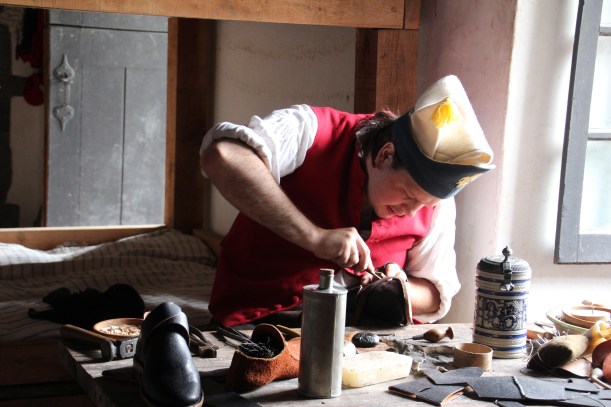
There is also a full time shoemaker at the fort. He said he learned the craft through apprenticeship. He makes all the shoes for everyone at the fort, and repairs old shoes.

Making 18th century shoes.

Making 18th century shoes.

Every soldier would get new clothes once a year. There would not necessarily be a shoemaker at the fort, most soldiers repaired their own clothes.

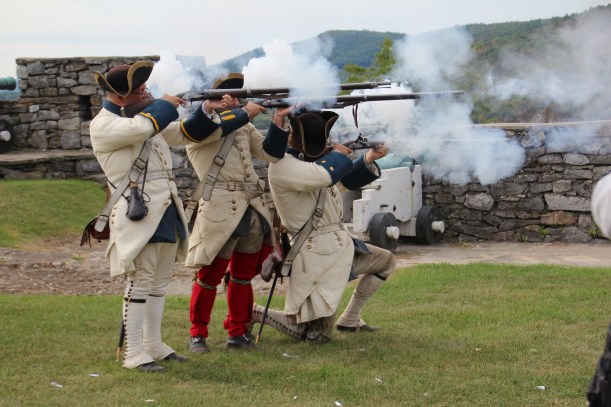
We also got to watch and learn about different battle techniques.

Ready, set, FIRE!

Ready, set, FIRE!

Then we went on a tour of the fort gardens. The area is located in very fertile farmland, so the fort had a 6 acre farm growing vegetables to augment that pea soup diet.

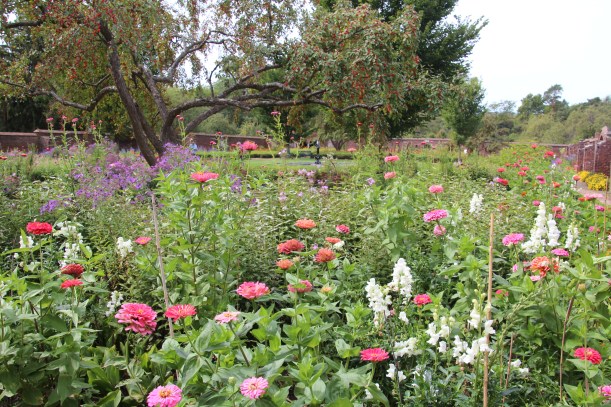
Beautiful gardens.

Beautiful gardens.

Today there is a small vegetable garden growing crops that would have been grown back in the 1700s.

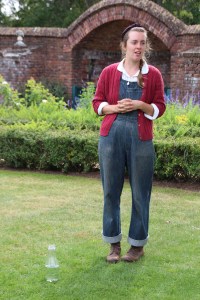
Our garden expert.

Our garden expert.

Everything that is harvested there is used in the fort restaurant.

In the early 1900s the fort and most of the peninsula was purchased by the Pell family. (Yes the Pell grant family.) They built a summer home near the gardens and began to restore the fort which was in ruins.

Over the years different members of the Pell family worked on the restoration and lived summers on the beautiful land. There was a house garden full of flowers inside a walled garden that is still maintained today.

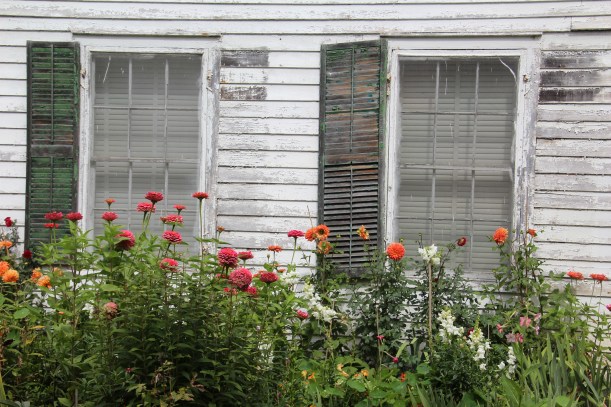
Pretty inside the walled garden.

Pretty inside the walled garden.

The house is falling into disrepair, and the park is working to find funding to preserve it as well.

Fixer-upper.

Fixer-upper.

The last talk of the day wasn’t held in the fort. It was across the lake, up on top of Mount Defiance. During one of the skirmishes someone took two cannons up to the top of that mountain to threaten the fort. It didn’t work…but the mountain was named at least in part because of that act.

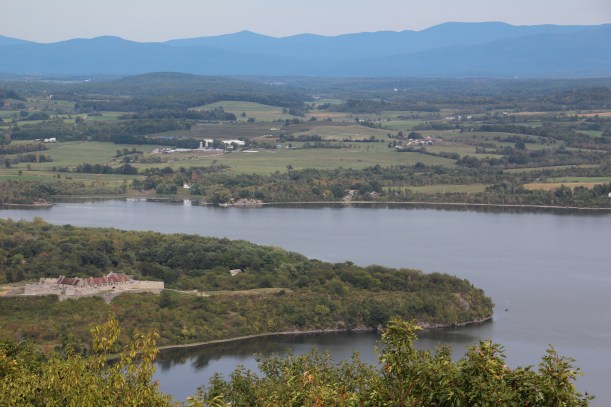
The fort stands strong.

The fort stands strong.

The view from the top of the mountain is stunning. You get a birds eye view of the fort and the surrounding country which is filled with rolling hills and farms.

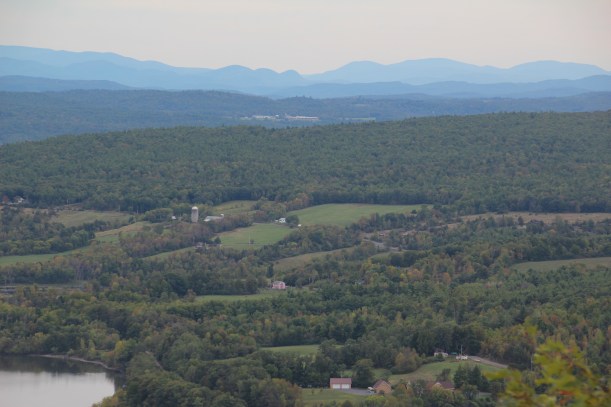
Farmland for as far as you can see.

Farmland for as far as you can see.

The talk on top of the mountain was about a specific battle between the British who had 3x as many troops as the French who were defending the fort. The British felt so sure that they could take the fort they had the local Indian chiefs sit up where we sat that day, to watch the battle. It didn’t turn out well for the British, but it’s a long story. I guess you’re just going to have to go visit the fort for yourself. I promise you won’t regret the time spent. I bet you’ll find yourself just like us, lingering, learning, listening.

And imagining.

The view from inside.

The view from inside.