
I’ve known Karen Mulvahill, author of The Lost Woman for more than 40 years as a friend, a coworker, a fellow outdoor loving camper, hiker, cross country skier, as a writer of poetry. But I haven’t known her as a literary author.
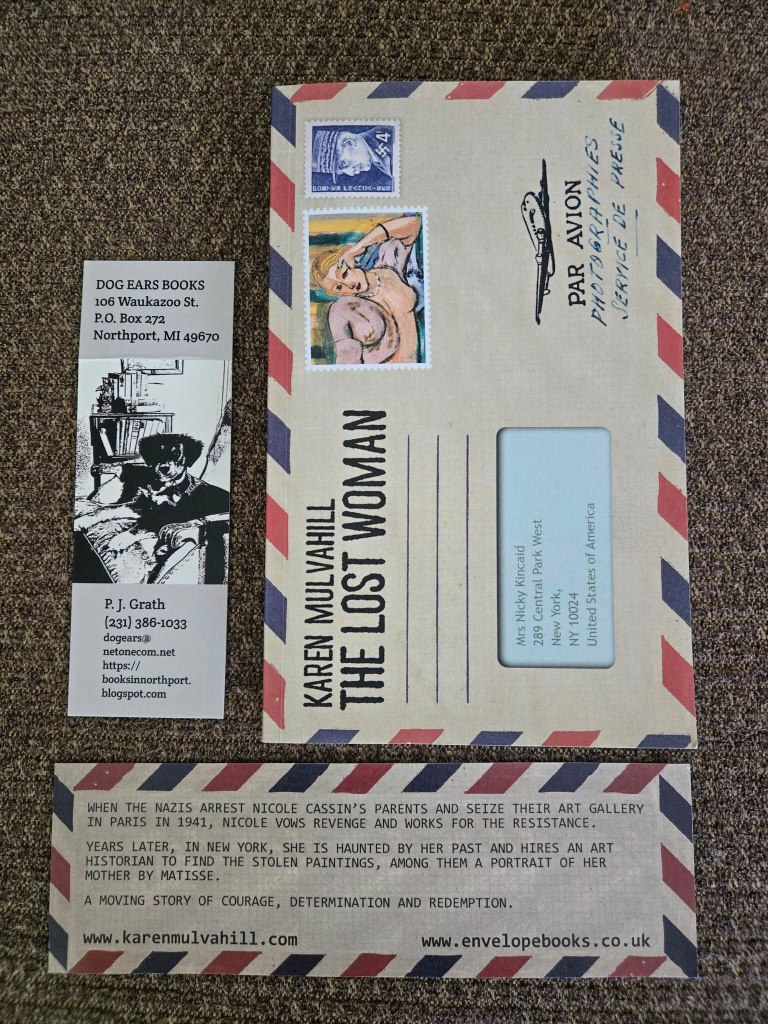
Sometimes she’d mention working on her book, or the frustration of finding an editor, or the writing group she belonged to and where she found support for her work or the struggle to find a publisher.
And then….just this spring….her book came out! After years of research and work and rewriting the book is here.
It was hard, but I waited until I could purchase the book from my favorite Independent Bookseller, Dog Ears Books, owned by Pamela Grath in Northport. The wait was worth it.
I read this book slowly, in small sips like a dessert drink, not wanting it to end. Which is saying a lot given the story revolves around German occupied Paris in World War II, and I am so not a fan of WWII books. But much of the story of the occupation and the treatment of the Jewish population is feeling familiar today, and that drew me in.
From the book; “The Nazi leardership were generally paunchy middle-aged men.” I have often, lately, voiced that I was tired of middle-aged white guys making decisions about our world that benefit themselves and rarely anyone else.
And then, one sentence I stopped and reread, from a description of a Jewish family rounded up from the streets of Paris, shoved into a car, and gone in an instant: “Well, they must have done something.” said the people wittnessing this disappearing.
I thought about how easy it has always been to believe people not like ourselves must have done something to warrant their experiences. Experiences we hope won’t come our way because we’re not like them.
I began to underline little bits, words strung together that made me smile or stop to consider:
“The river shuddered under a light breeze that churned the intermittent sunlight into the depths.”
“I bounded up the stairs as if I weren’t contained by my own skin.”
“Did my armor ward off as much joy as grief?”
“As they turned up a gravel driveway, dust curled behind the truck, erasing the places he had been.”
You, reading this book, will have different bits underlined, maybe different places that call you to pause and consider. By the end you’ll have your own interpretation of what Paris and the art world was like during the occupation, and perhaps a better understanding of what resistance looked like then and what it might look like today.
I have to thank my friend, the author, for writing this book. Because I know her I read it. Because I read it I am more aware. And being aware is infinitely more desirable than assuming “they must have done something.”
 Change Is Hard