Lately, not often, but once in awhile, I notice something in my periphery vision that looks like a person standing off in the distance. Down the road, across the lawn, far away. It’s just a moment, mostly a dark grey shadow, and when I look directly there’s nothing there. Once in awhile there’s a small tree or a mailbox but lots of times there’s nothing there at all.
I brought it up with my nurse practicioner at my annual physical and she asked me if I had told my ophthalmologist. I hadn’t but I had an appointment coming up, so I said I would. Today I sat in the chair with my eyes dialated and told him the story.
He started smiling and said he usually sees this in 90 year old people. And that it’s just my brain that sees something and fills in the rest to create, for a moment, something that makes sense. I had thought that was what was going on myself, so was relieved when he looked in my eyes and didn’t see anything to worry about.
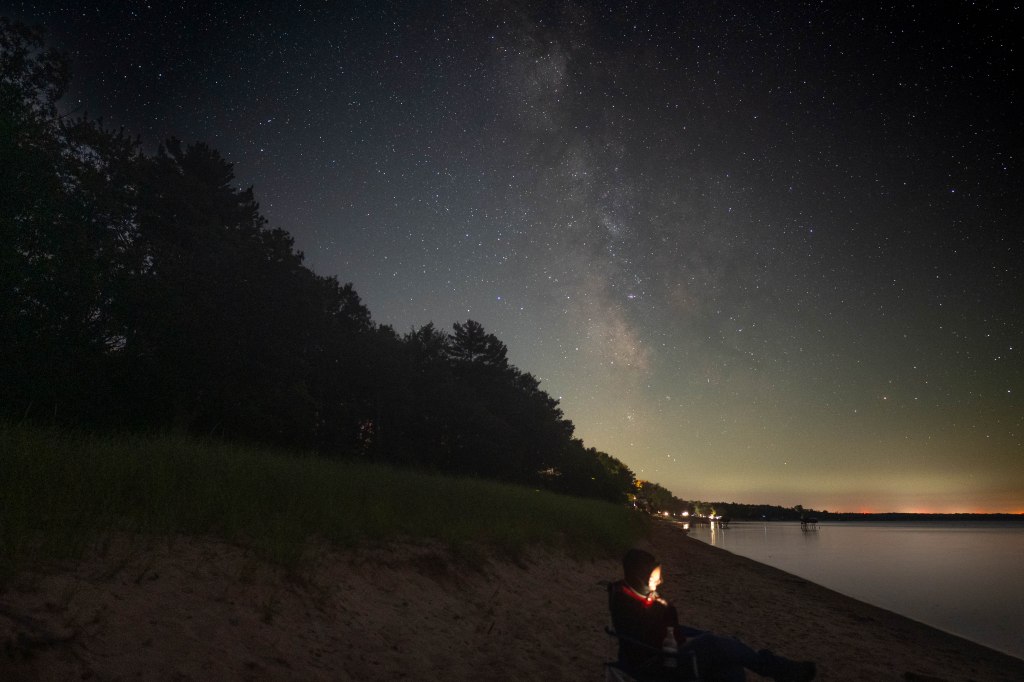
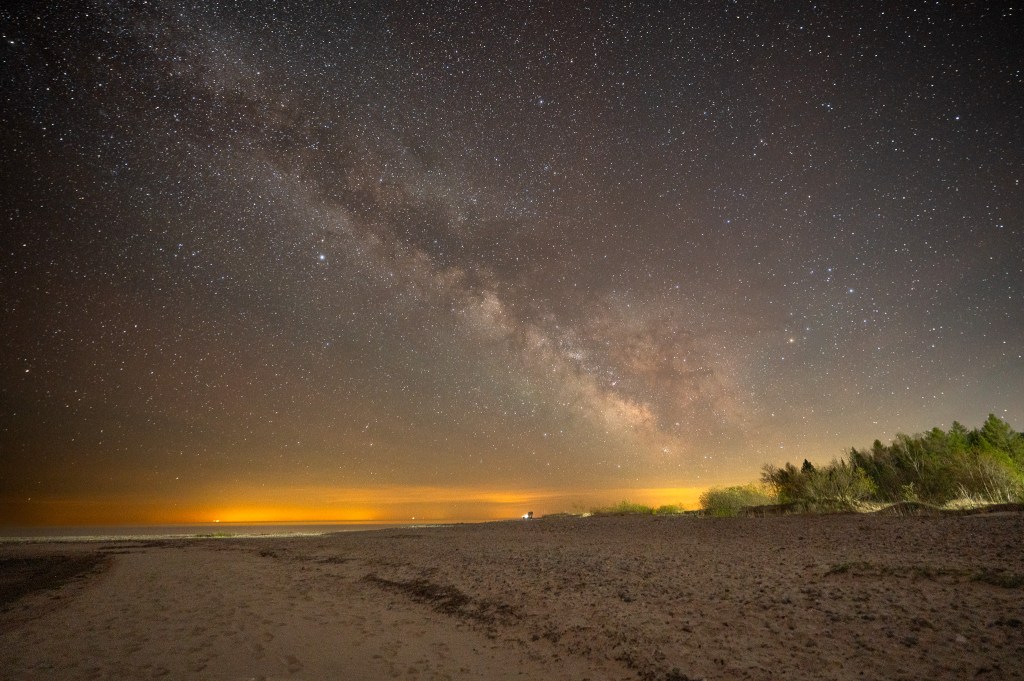
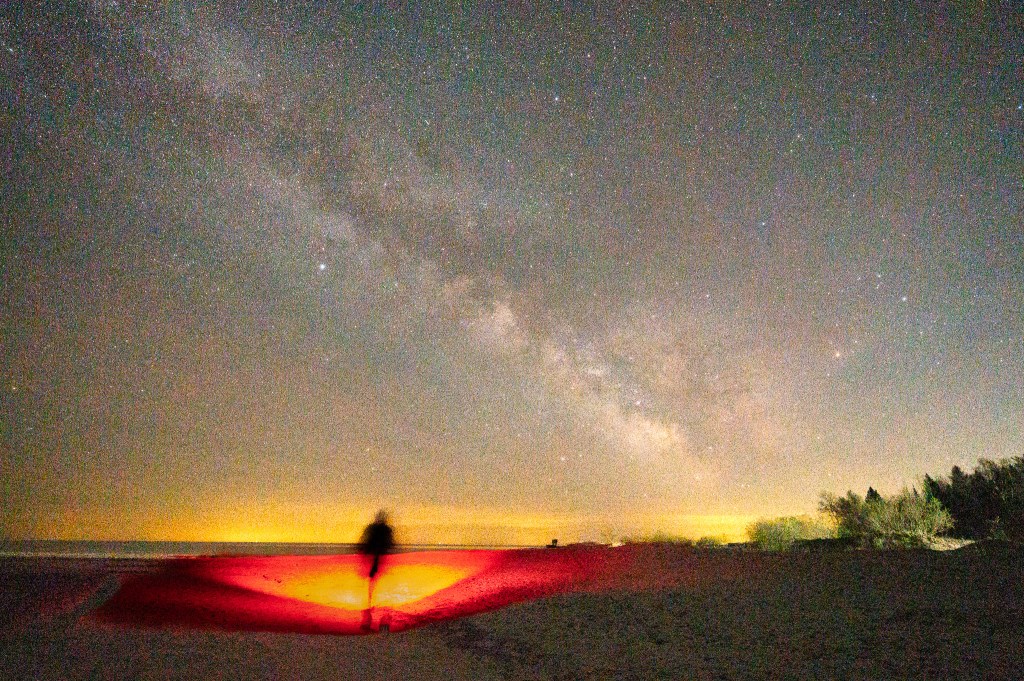
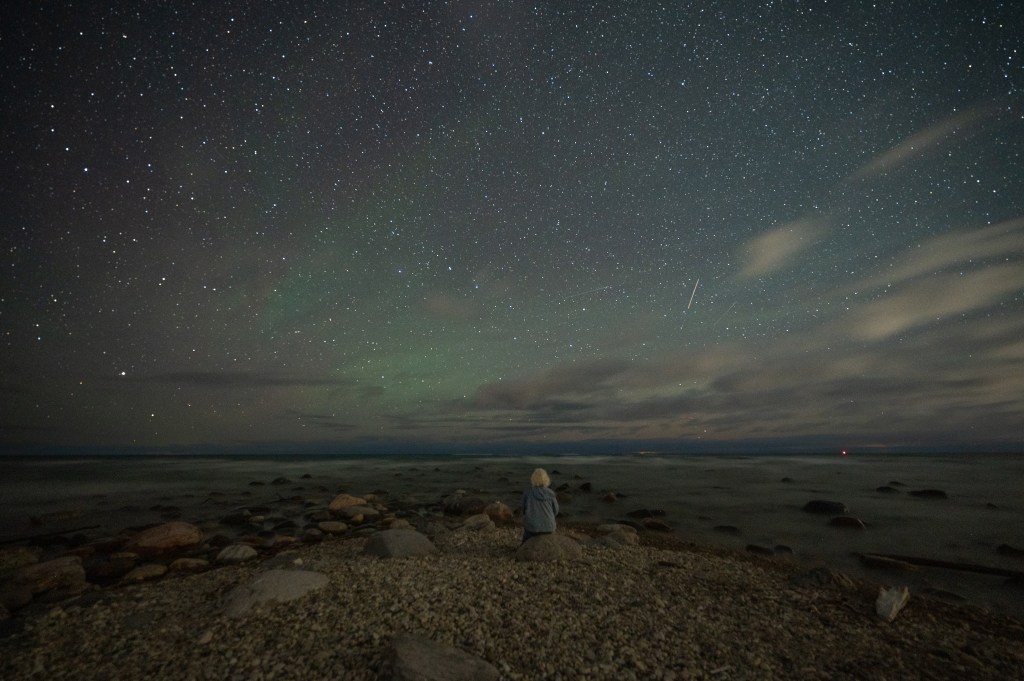
But the whole experience reminded me of something that happened when I was processing photos from my night under the stars with a friend and her daughter. I processed one photo where the daughter’s phone was shining down near the bottom of the frame. I had been shooting the stars above her, but sometimes she ended up in the image.
On this particular photo, one of the first I worked on, I thought it was just her phone that was glowing. I used the ‘remove’ button in Lightroom to get rid of that glowing shape. I had never used that function before. I edited the rest of the image, knowing the whole bottom 1/3 of the picture was dark beach.
Turns out it was her face that was lit up, and when I erased her face I left the rest of her body intact. That is, if you read the instructions on how to use this button, a problem.
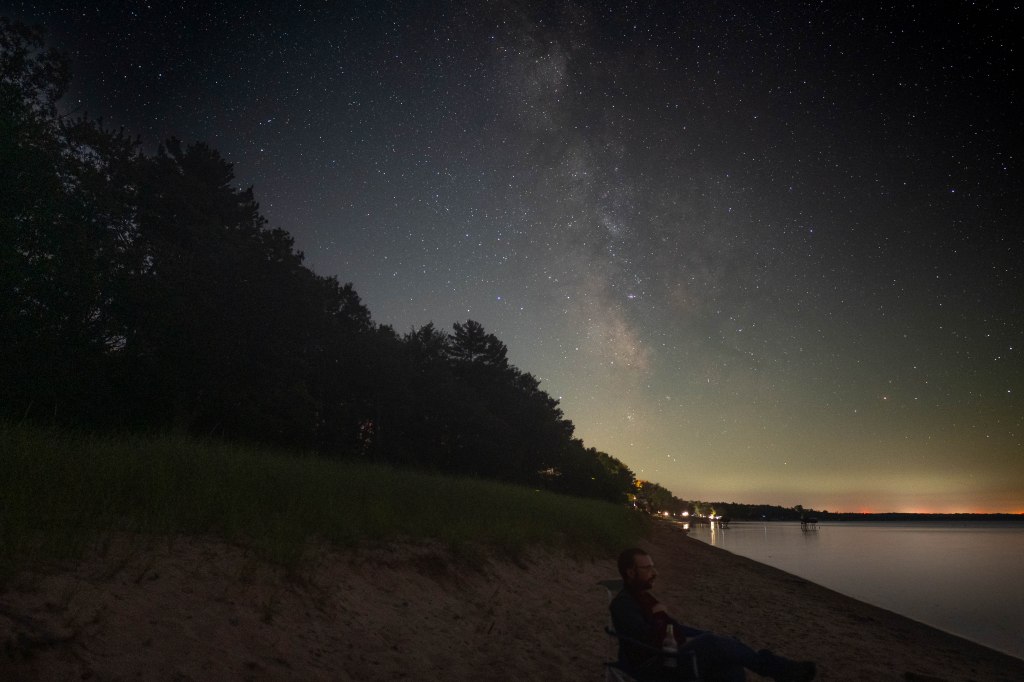
Witout knowing any of this I thought maybe I’d lighten up the dark beach just a touch and see how that looked beneath the Milky Way. And I got this:
Turns out I had only disappeared her face, and Lightroom, with it’s infinite AI wisdom knew there couldn’t be a person with no face, so it created one for me. If you look carefully you’ll see a guy sitting in a chair. The chair that was right there with us all night.
I actually thought for a couple minutes that some guy had joined us for the night of star gazing, even though I knew there was no guy there. And then I shared the new image with my friend and her daughter and they freaked out too.
No, no guy quietly came and sat in our chair. It’s just that AI completed the person I had left in the image. Just like my brain completes the image it thinks it sees out of the side of my eye.
No wonder it’s hard to know what the truth is anymore.
We went to the Upper Peninsula of Michigan during a very specific week in August, a week when the moon wasn’t filling the sky with light, in order to capture the dark skies there and the Milky Way hanging high overhead.
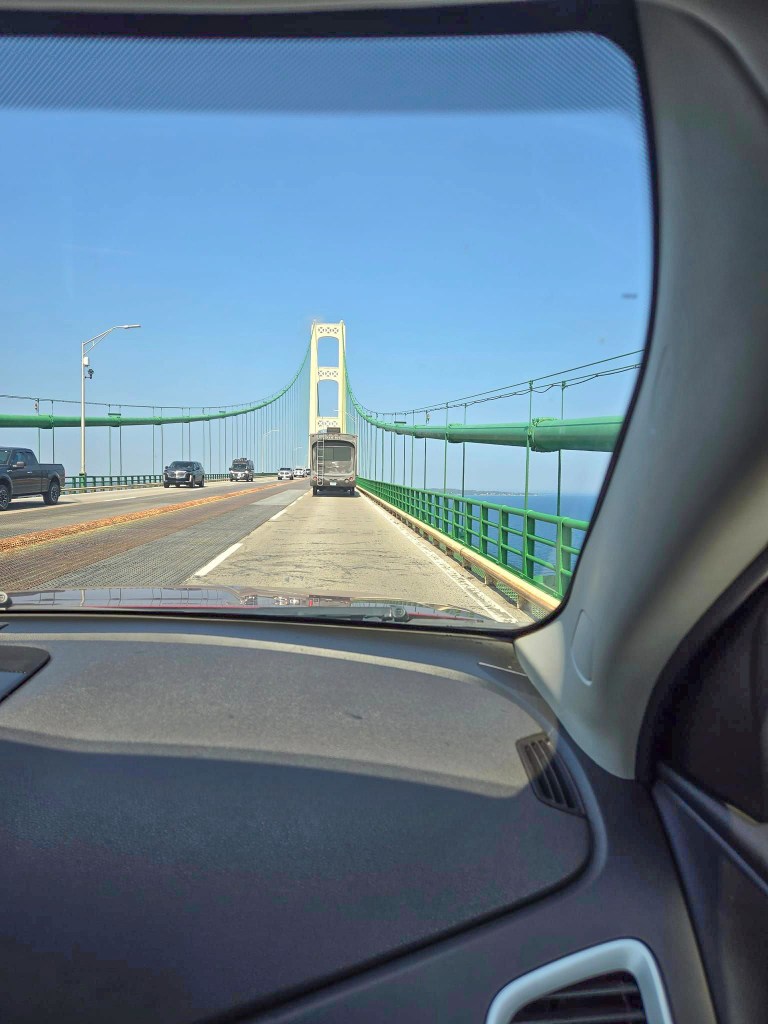
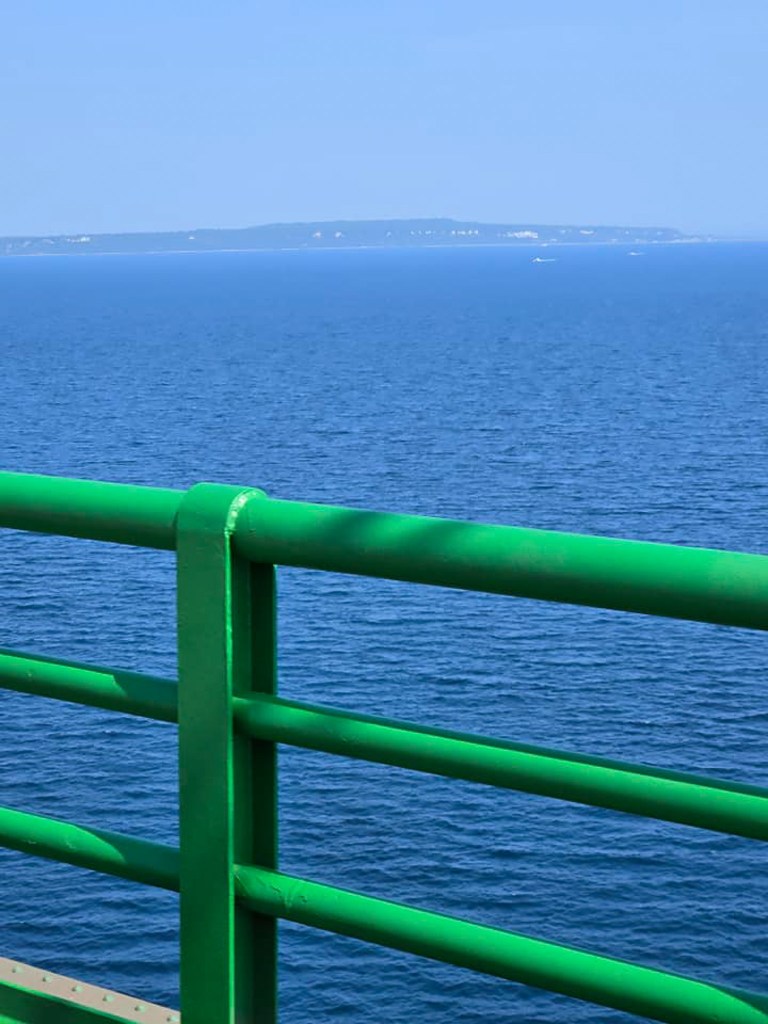
I concentrated on driving, my sister took the pictures as we went over the bridge.
The season for Milky Way core shooting is coming to an end. Soon it won’t rise high enough for us to see it, and we’ll have to be content with the memories of magical clear nights filled with stars. Because certainly that’s what it’s always like when you’re out under the stars shooting the Milky Way. Right?
Sure it is.
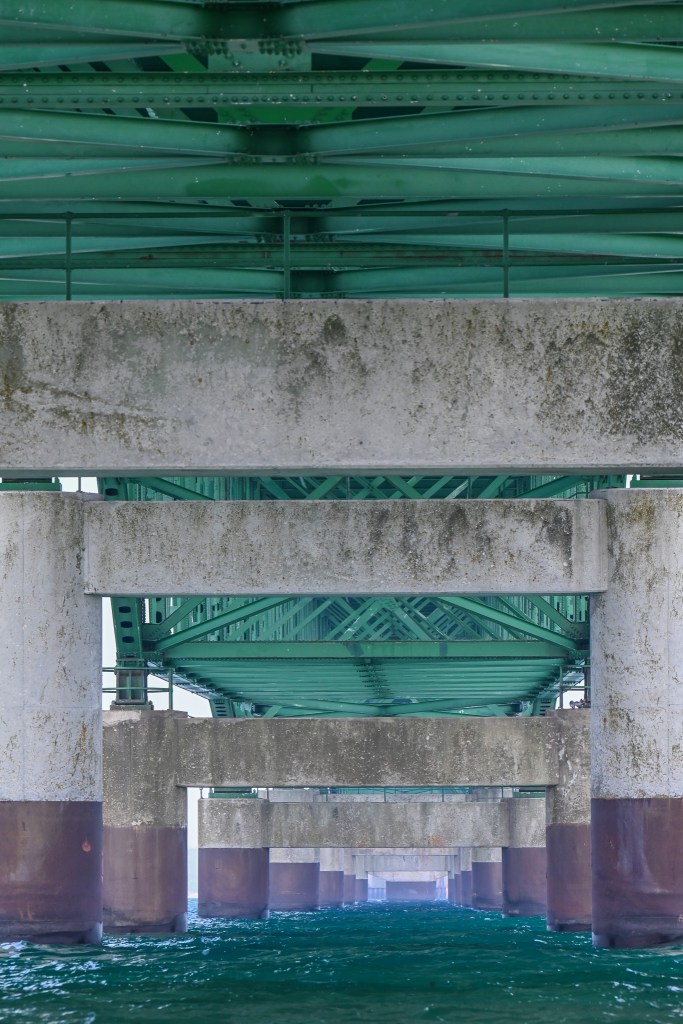
Under the bridge before we drove over it.
So that Monday at the end of August my sister and I packed the car and drove all the way up from southeastern Michigan, across the Mackinaw Bridge and into the interior of the eastern part of the Upper Peninsula.
That’s Mackinaw Island over there.
We set up camp and then decided we’d head up to Whitefish Point for the sunset. And, if we were lucky, a bit of Milky Way practice too.
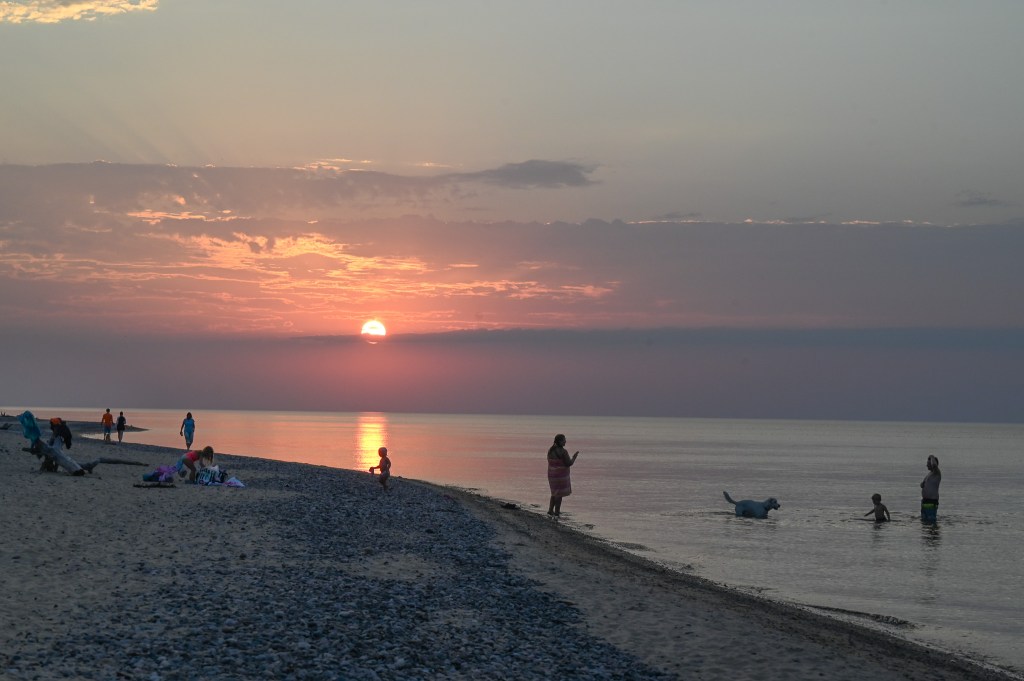
Lots of families had spent the day at the beach.
The Milky Way core rises early in the night at this time of year, so all we had to do was wait for it to get dark. The minutes ticked by slowly as the light faded and many families came in from the beach, packed their kids and stuff into their cars, and drove away.
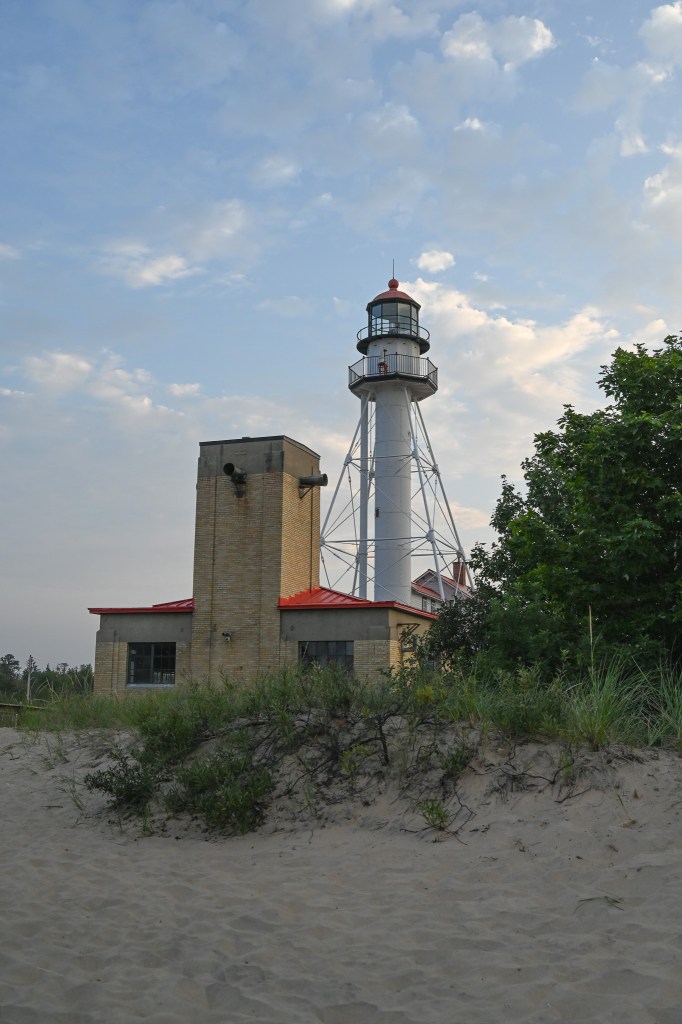
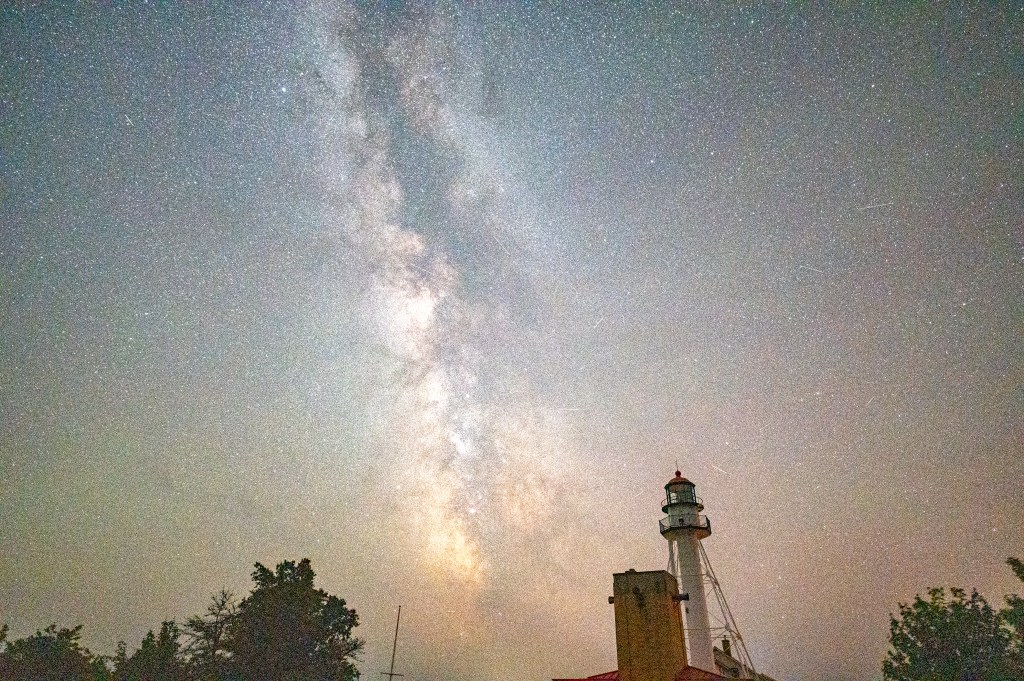
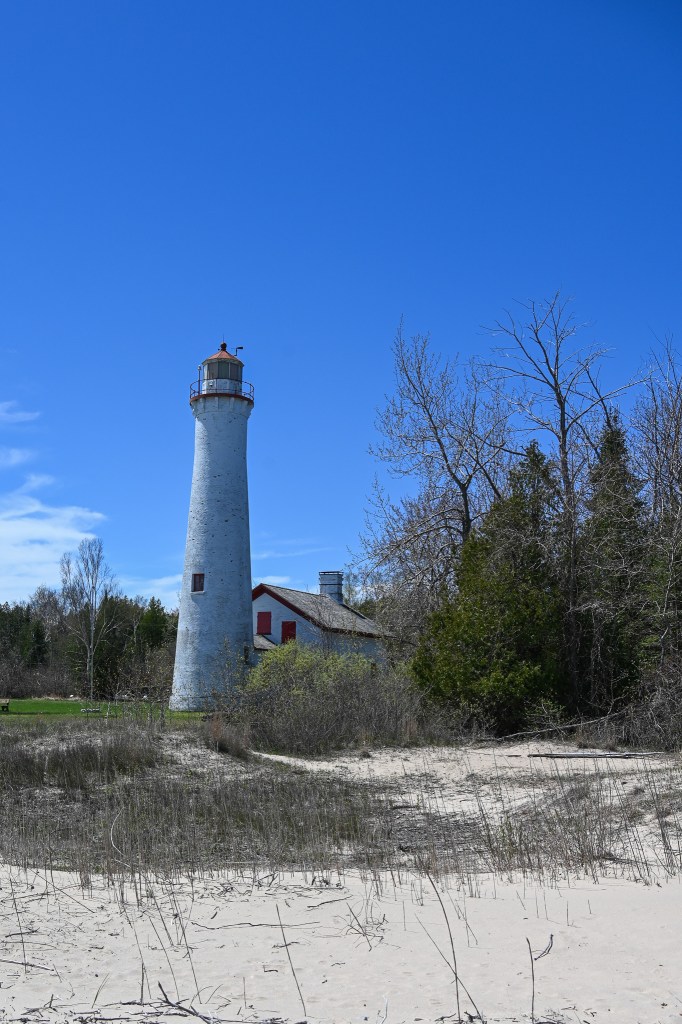
This is a uniquely built lighthouse.
But many other people were still out on the beach as the skies darkened, slow to leave Lake Superior and a day filled with sunshine, splashing in the lake, and looking for that special rock.
The day’s light fades.
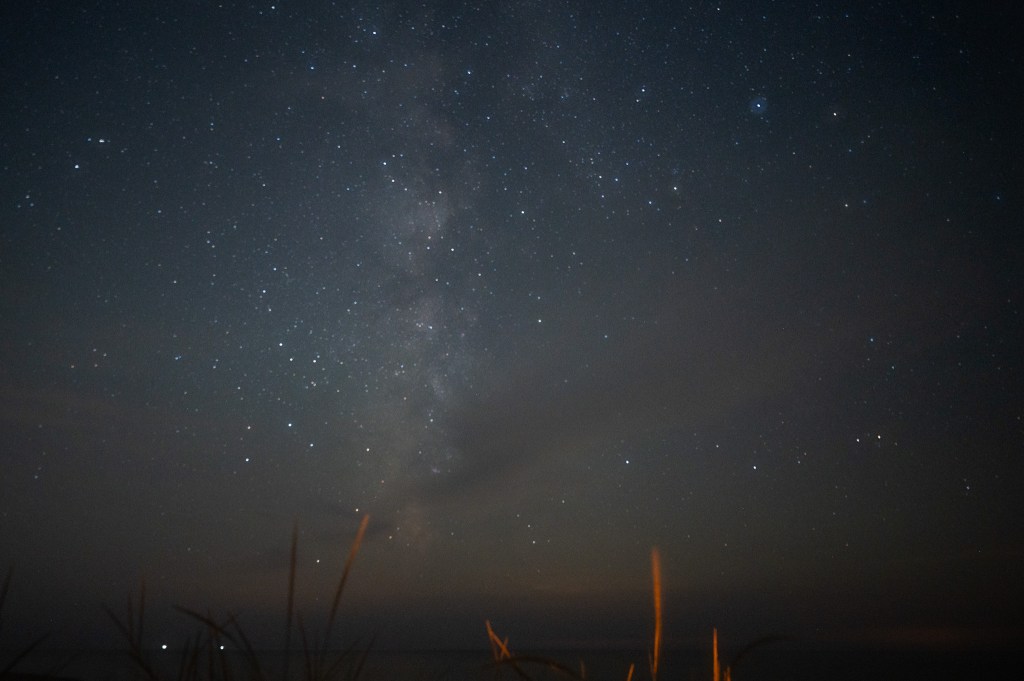
According to what I could find online the Milky Way would be visible around 10:15. By 9:45 we were getting tired of waiting and I climbed out of the car to do a test shot from the parking lot to see if it was there.
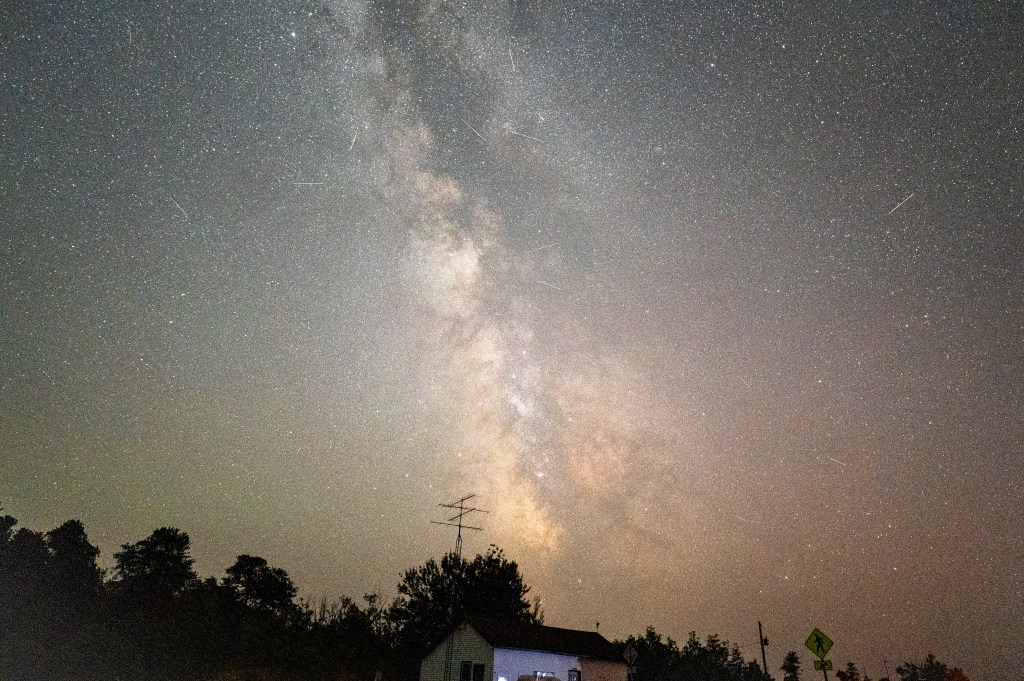
If you look at this in a dark room and make it bigger you’ll see satellites flying all through the sky.
Unfocused and with no composition to speak of, the image is over exposed on purpose so I didn’t have to wait 25 seconds just to see what was up there. We were very excited to see that the Milky Way was indeed hanging over our heads.
So off to the beach we went. We had planned to shoot from down near the water, but there were hundreds of biting flies down there. I felt more comfortable up on the boardwalk where the night breezes kept the flies at bay.
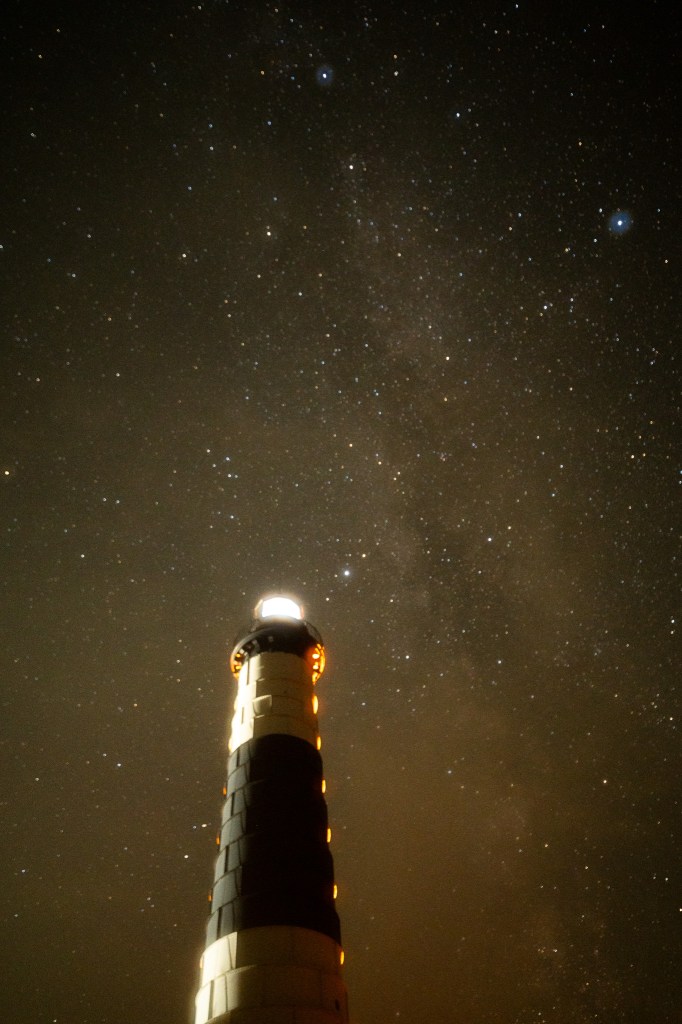
Over exposed on purpose again, just to get a quick image to see where the Milky Way was in relationship to the lighthouse.
Besides, this wasn’t meant to be our real night photography session. We’d come up to Tahquamenon Falls State park to shoot the Milky Way over the falls. This was just a practice session, nothing really important.
Once I established where the Milky Way was, and got the stars in focus, I settled in to get a serious shot. But there were still people walking up from the beach, flashlights shining on random things. Car taillights and headlights were shining on the lighthouse when you least expected it.
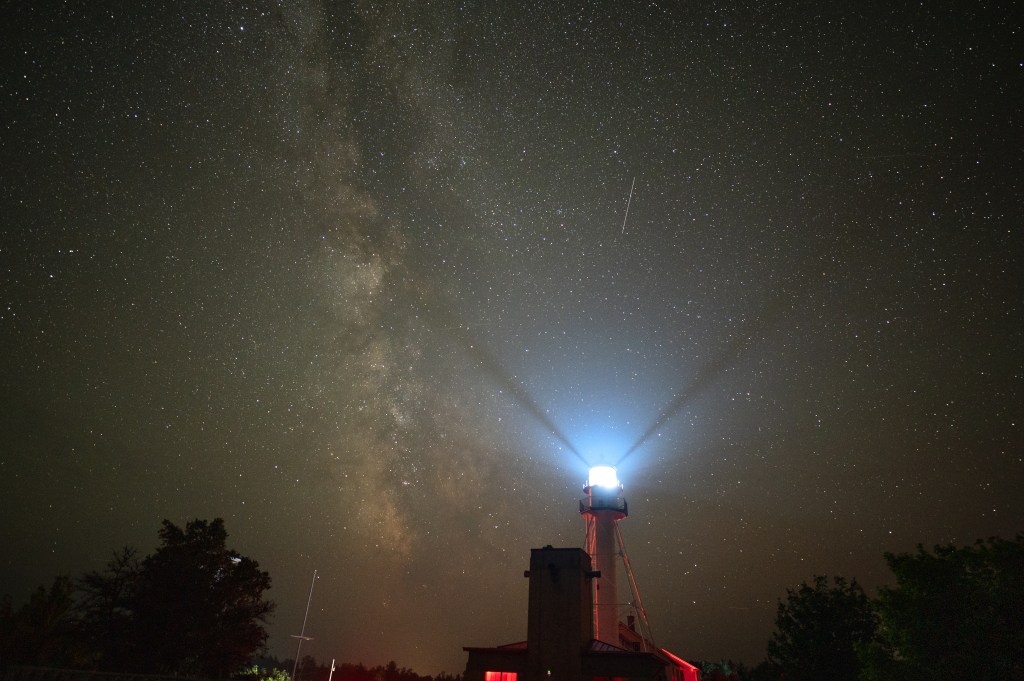
The red from car taillights lit up the side of the lighthouse. And of course the lighthouse beacon made plenty of light too.
Not to mention the actual light from the lighthouse which every 14 seconds would blast two times. My sister counted the seconds for me as I tried to avoid the light. Though to be honest the beacon light looked kind of cool on the back of the camera and I didn’t mind it so much at all.
But then there was that red light near the bottom of the frame. I couldn’t tell what it was, while looking through the lens, but the camera was definitely picking something up. It was annoying, and meant that I really needed to limit myself to the top portion of the lighthouse.
Easy enough to crop out that bit of red at the bottom. Turns out it was an exit light inside, above a door, that filled the room with red light.
And as I focused on the sky above the lighthouse there were, of course, planes to contend with. You can take a series of images, all in a row, and then ‘stack’ them in a software program and the parts of the images that aren’t the same will be removed. So I took 7 or 8 images, and if I wanted to I could stack them and all the planes and satellites would be eliminated.
Or…you could just say, that’s cool, look at all the stuff up there in the sky!
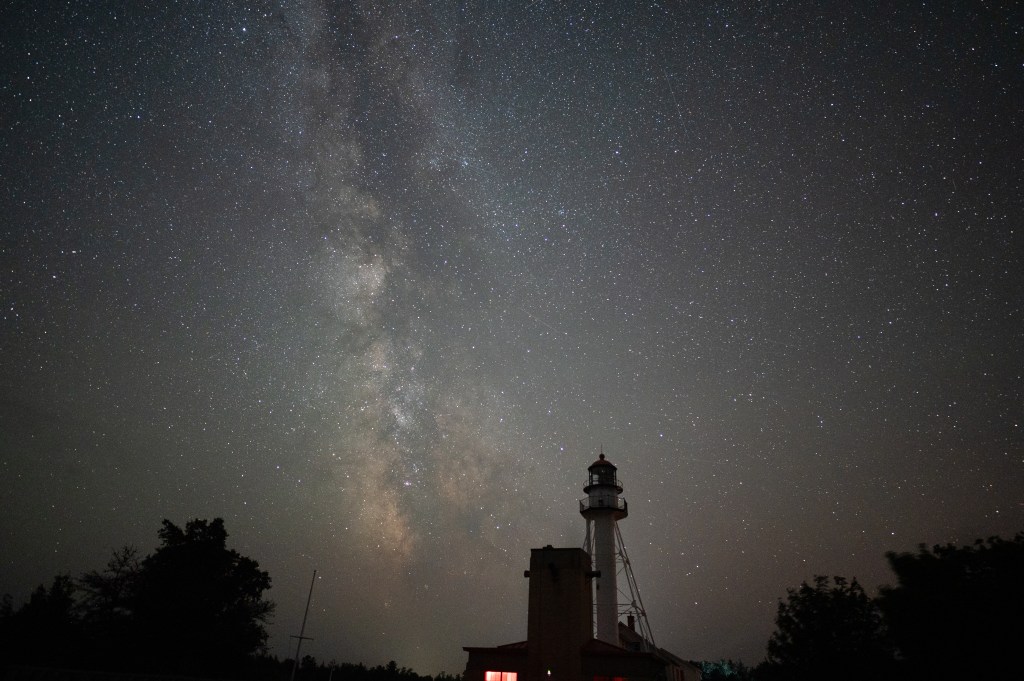
Well, I got the shot without the beacon, but there was a plane flying through the Milky Way.
I didn’t take a lot of images that night. I probably should have gone down to the beach and worked on my original composition plan. It was a warm, beautiful night. But we were both tired from a long day and this was just a practice shoot anyway.
A car’s headlights lit up the side of the lighthouse, but I sort of like this one.
Right?
In the end I liked a couple of the images. And I’ll definitely go back on another clear, warm night. A night with a breeze to keep the flies away. Maybe a night earlier in the season when the Milky Way will be visible later in the night and fewer people will be around with their flashlights and headlights.
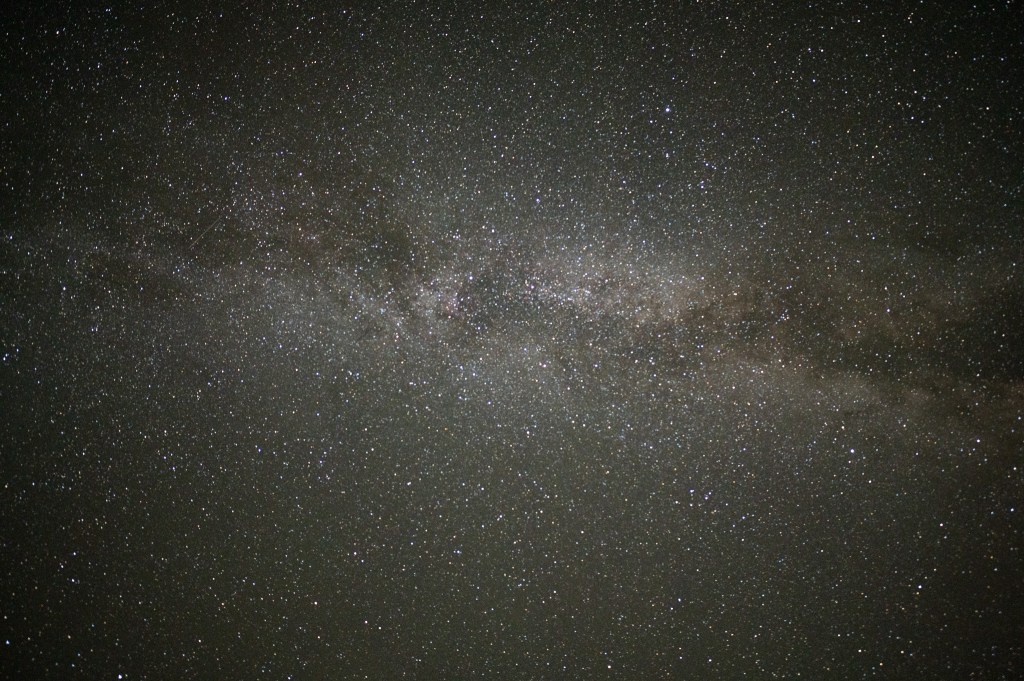
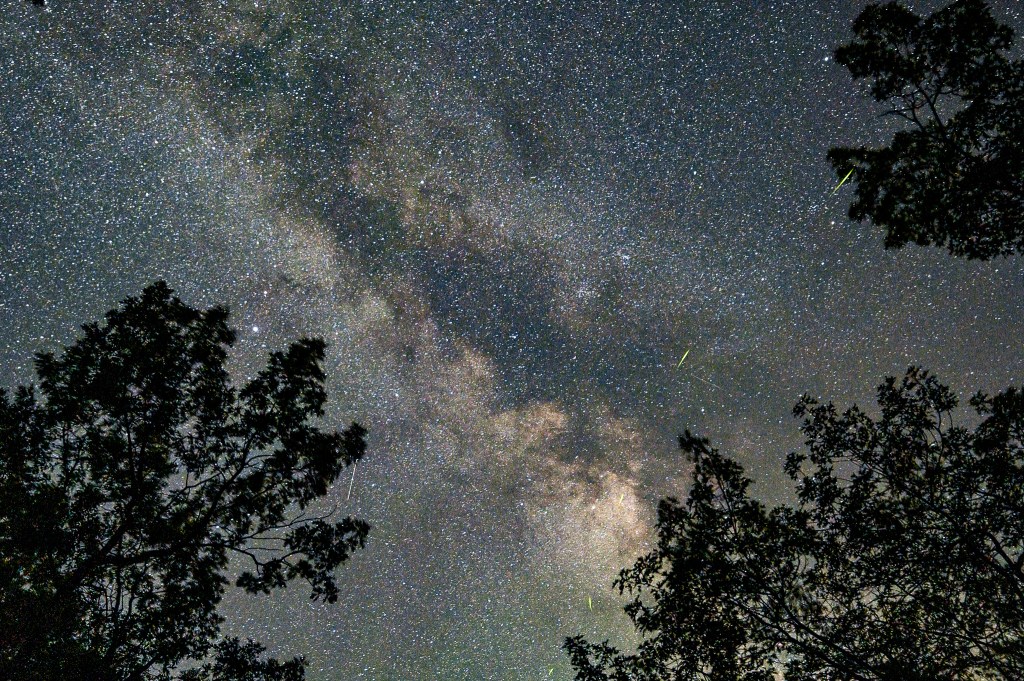
The northern end of the Milky Way, right over our heads. So many stars, such a lovely night.
And of course I still had the Milky Way shoot above Tahquamenon Falls to look forward to. This was just a practice session, remembering how to focus and camera settings and stuff. But you’ll have to wait to see how that one turned out. I haven’t processed those images yet.
Heck, just retelling the story of our very long first day in the UP has exhausted me! But I hope you enjoyed your short trip to Whitefish Point on a warm August night!
Let’s see. When I left you last my sister and I had driven a few hours north, scoped out a potential night sky photography site at a lighthouse, and set up our campsite at Harrisville State Park.
The view from our campsite.
The purpose of this three night camping adventure was to capture the Milky Way in darker skies than those around my house. I’d made the three night reservation six months ago in order to get a prime Lake Huron shoreline site.
I was sure that at least one night would have clear skies.
A view of the lighthouse from about where we planed to stand later that night.
Based on weather forecasts it looked like Monday night/Tuesday morning was my only chance. So we set our phone alarms to get us up at 2:00 a.m. and in the early morning darkness we drove the few miles to the lighthouse.
We quickly found the “X” we had drawn in the sand earlier in the day and began to set up shop. But while I was lengthening the tripod legs I noticed a light way out on the horizon, shining just above the bench I intended to use as a foreground. The light bothered me because it was so bright.
See that light in the middle of the horizon? It was a lot brighter than it looks here. The orange is light pollution.
I took a couple shots but didn’t like what I was seeing.
Too much light from towns to the south.
I decided to shorten the tripod legs in an attempt to hide the light behind the dune. I sent my sister over to the bench so I could try to focus on it, intending for it to be in the foreground which would be stitched together with another image with the focus being the stars.
She’s walking back using the red light. You can still see some of that bright light on the horizon to the right of her.
That didn’t work, I couldn’t focus on her at all, so I gave up that theory. Plus we were too far away from the bench and if I moved closer there would be that darn light out there on the horizon.
I decided to just try for a single image, nothing I had to stitch together later, just practicing getting the stars in focus. That worked and I took several of the same image so I’d have some spares to practice stacking when I got back home.
You can see the bench, but it’s really small and there’s too much light pollution.
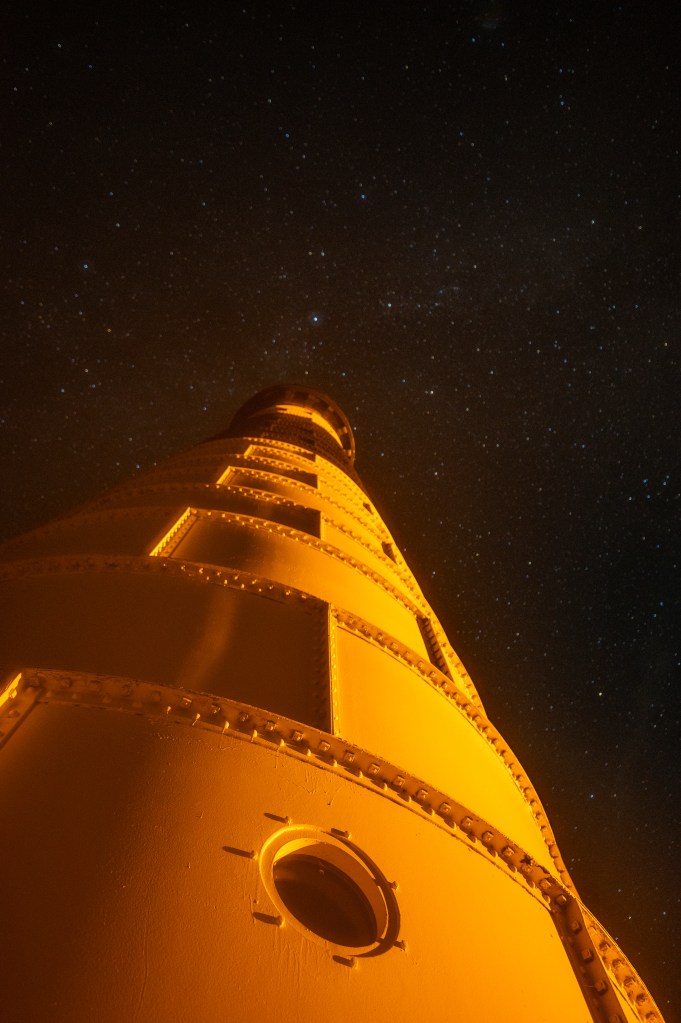
But all the time I was focused on the Milky Way I’d been distracted by the lighthouse to my right. The grounds had a single large light on the other side of the building which was lighting up the side of the tower. I thought it was beautiful and wanted to get a shot of that even if it wasn’t a Milky Way image.
I started to move the camera around while not realizing the shutter was still open.
So once I was done with the multitude of stackable images of the Milky Way, and feeling disappointed in the images I had so far, I turned the camera toward the lighthouse. And the first test image I took I realized included a small part of the Milky Way!
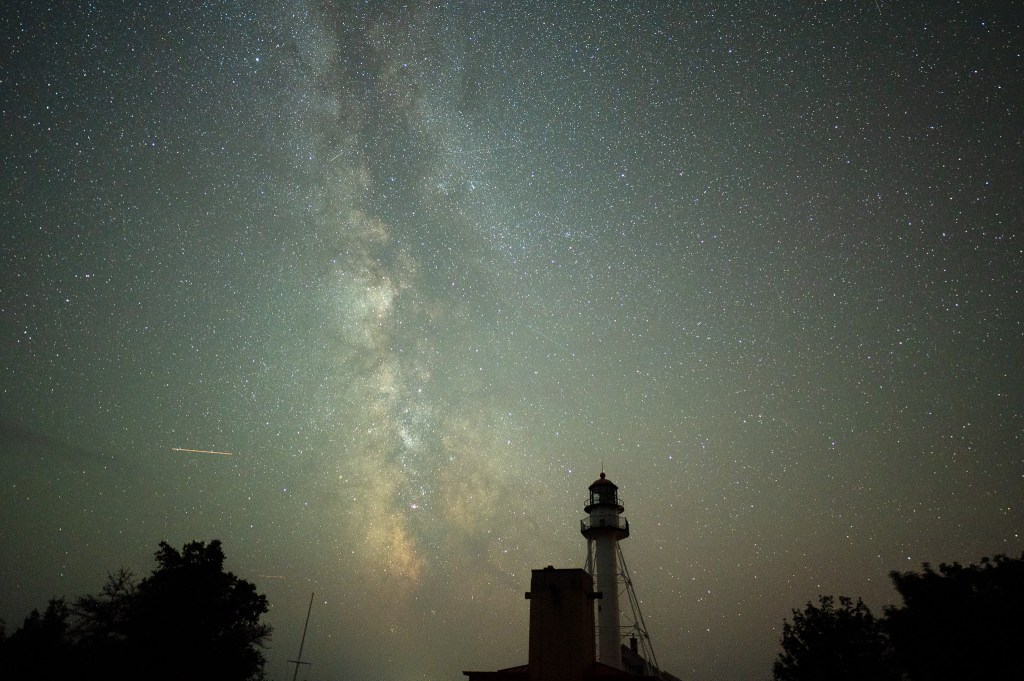
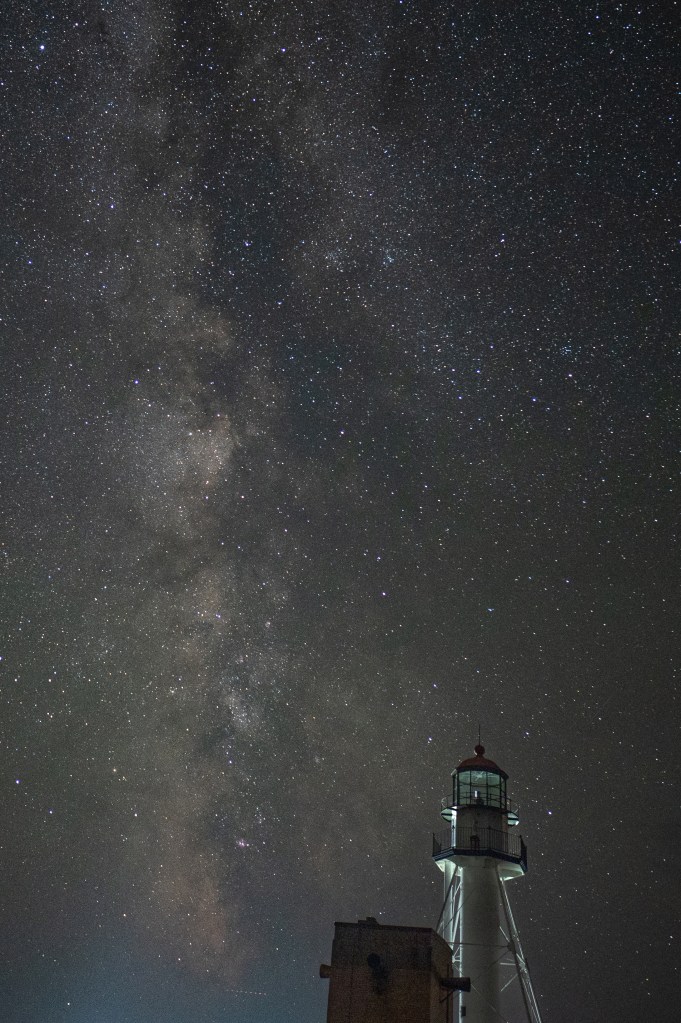
How exciting, it was possible to get the Milky Way and the lighthouse in the same image! Quickly I shifted the camera to the right. And this is what I saw:
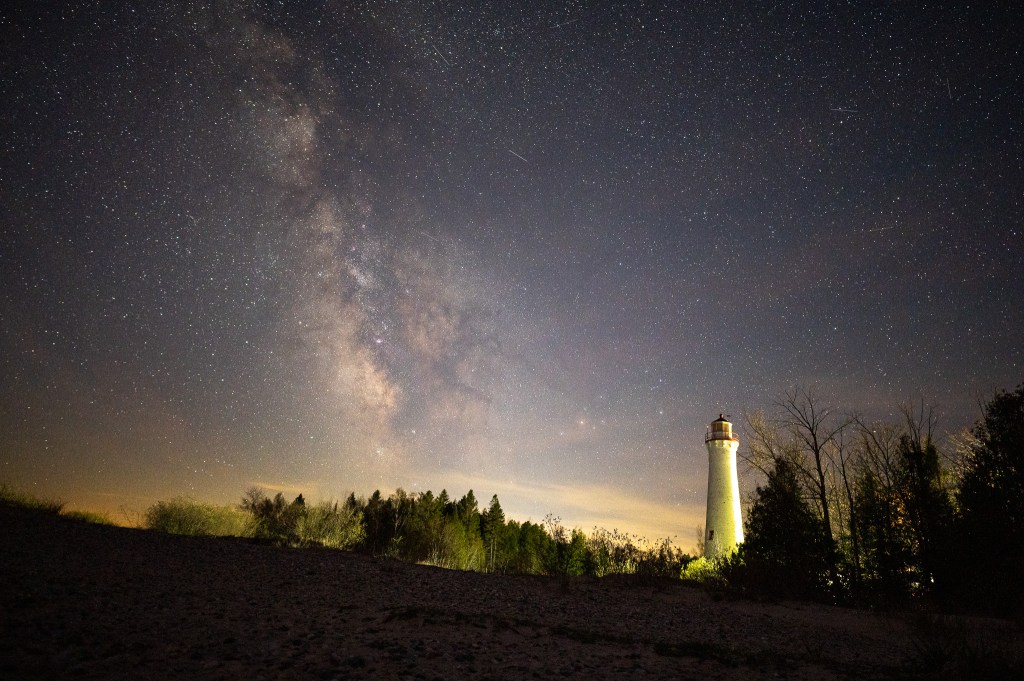
Nikon Z6ii, 20 mm, iso 3200, 12 seconds.
The yard light they had perfectly lit the tower without being obscene. I had enough time in between flashes of light to get the image because there was so much other light around. And by moving to the right I had eliminated most of the ugly orange light pollution that blasted out over the lake.
I was thrilled.
The rest of the night I worked on getting the best composition, and then taking multiple shots to stack later. I think I was also trying to get one image with the lighthouse in focus that I could use as a foreground to be blended with my best sky shot.
To be honest I don’t know if I did that. I haven’t looked closely at all the images yet. I fell in love with the single image I’m showing you now and sort of stopped looking after that.
It’s such a great reminder of the entire adventure.
If I don’t end up doing anything more with these I’ll still be happy. I need to read the study guides in my online class to learn how to do blends where part of the image is from one shot with the foreground in focus and the rest of the image is from a sky shot with the stars in focus. It can’t be that hard. Right?
Right???!
So what did we do the rest of our three nights at Harrisville? Well…this has gotten too long already so once again you’ll have to wait and see. But I don’t think anything we did the rest of our time there will top that first night.
Hint: There were no more clear skies, day OR night!
When I’m out shooting the stars I don’t feel the cold. My sister, who was patiently waiting for me was marching up and down the beach trying to thaw her toes. I didn’t notice the cold until we got back to the car, and then I realized I was cold to the core.
We got back to camp about 5 a.m. and headed to our tents to get one hour of sleep before the 6 a.m. sunrise which we wanted to photograph. But we were both so cold all we did was shiver in our tents, even with our electric blankets, as we waited for the sun to come up.
The first hint of sunrise.
And after we got a couple shots with the sun rising we scurried to McDonalds to get a hot cup of coffee and a breakfast sandwich. It took a couple hours before we were ready to head back to our tents for a nap.
It was pretty but we were too cold to appreciate it.
Warm was good.
So Monday night/Tuesday morning was the highlight of our camping adventure. Would it be worth it to stick around Harrisville for the rest of our reservation? Hard to say. When I get some more time I’ll show you around town.
A week or two ago I made a last minute decision to head back up into the thumb of Michigan, because the weather was going to be clear, and because I was able to book a campsite.
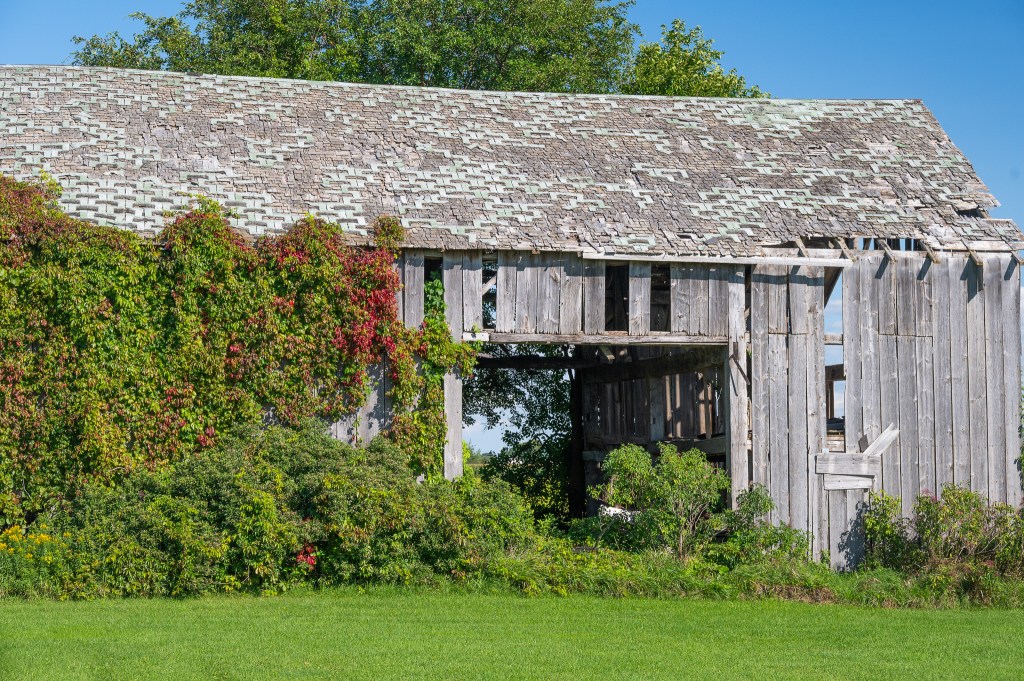
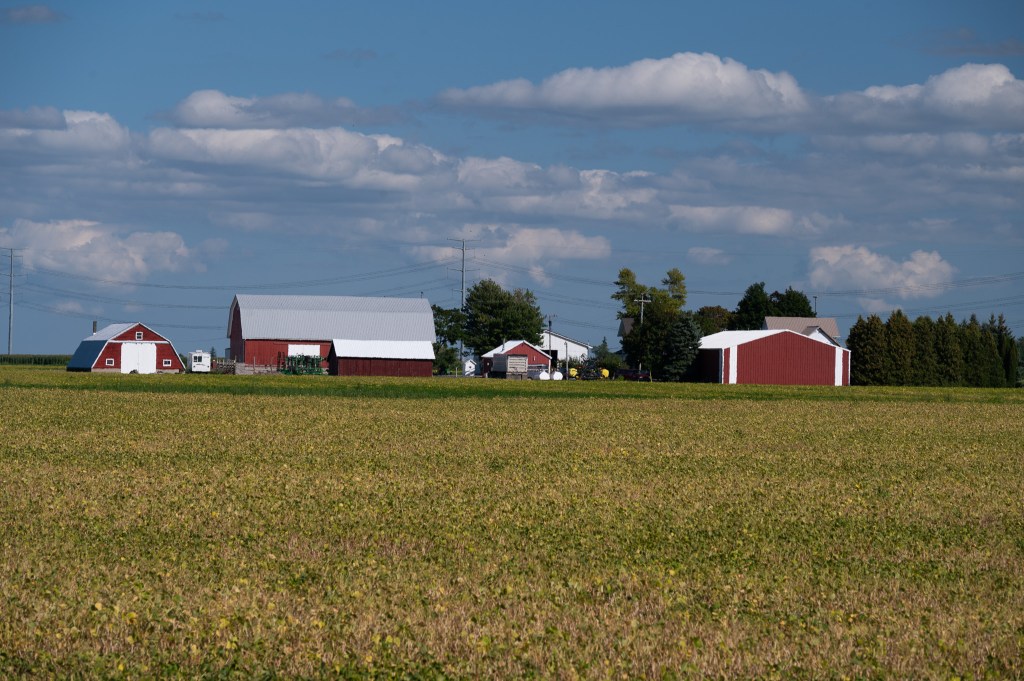
On the way up I, naturally, shot a few photogenic barns.
I wanted to try one more time to get that elusive Milky Way in a place that is darker than my Bortle 4/5 here at home.
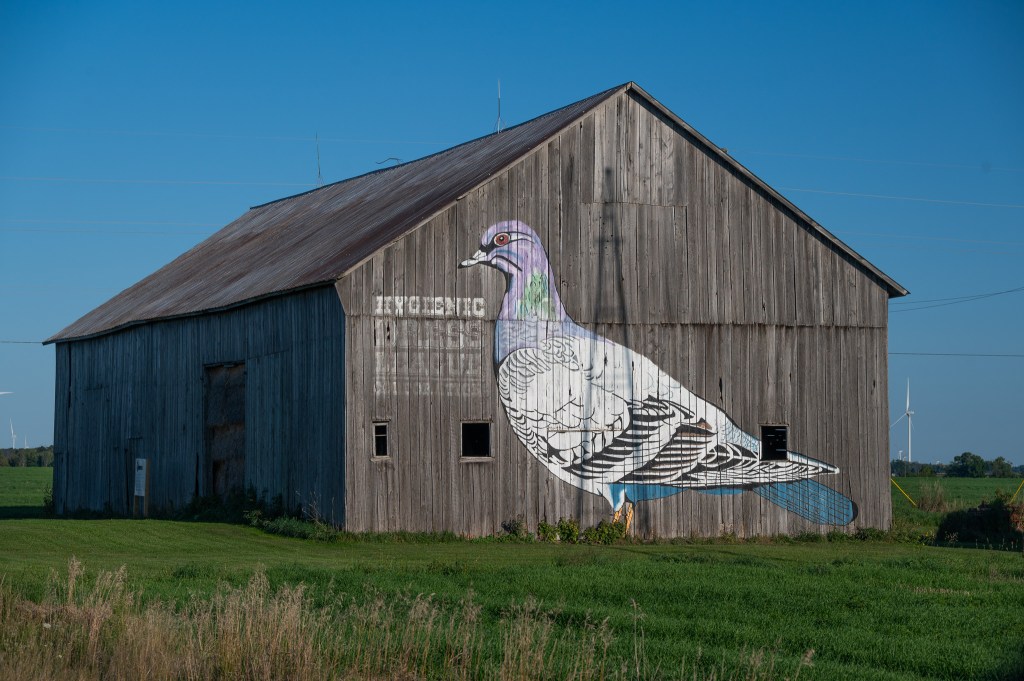
My fovorite barn in the thumb, it’s located near Pigion, Michigan. Of course.
Plus, I knew I’d get to drive through those yellow soybean fields again, and I might find a barn or two or three worth stopping for.
Red barns in a yellow soybean field.
And of course I did.
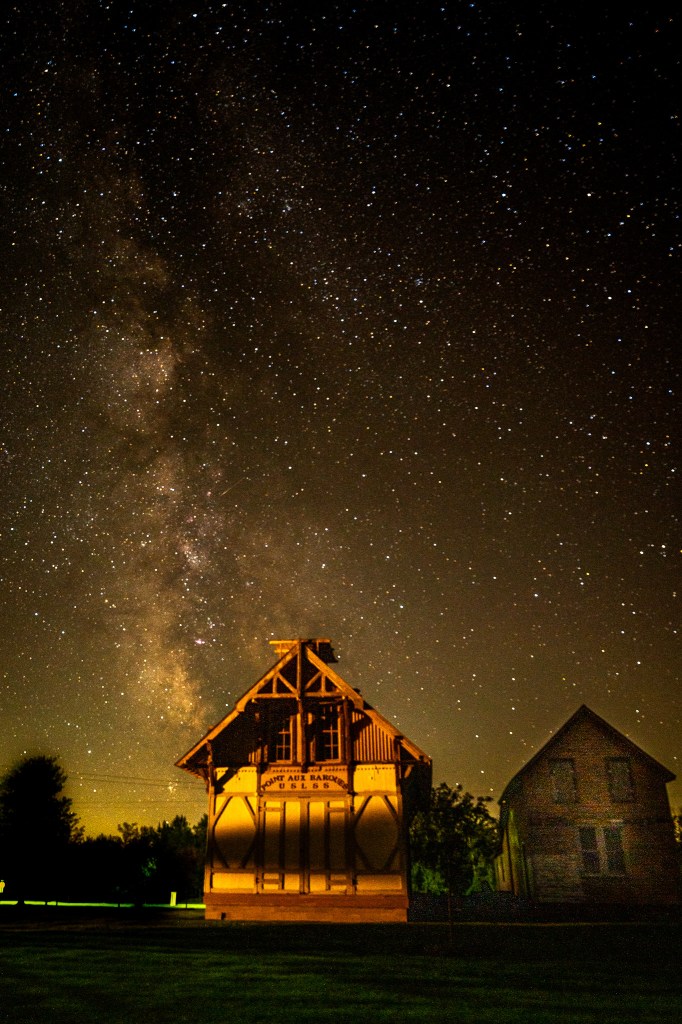
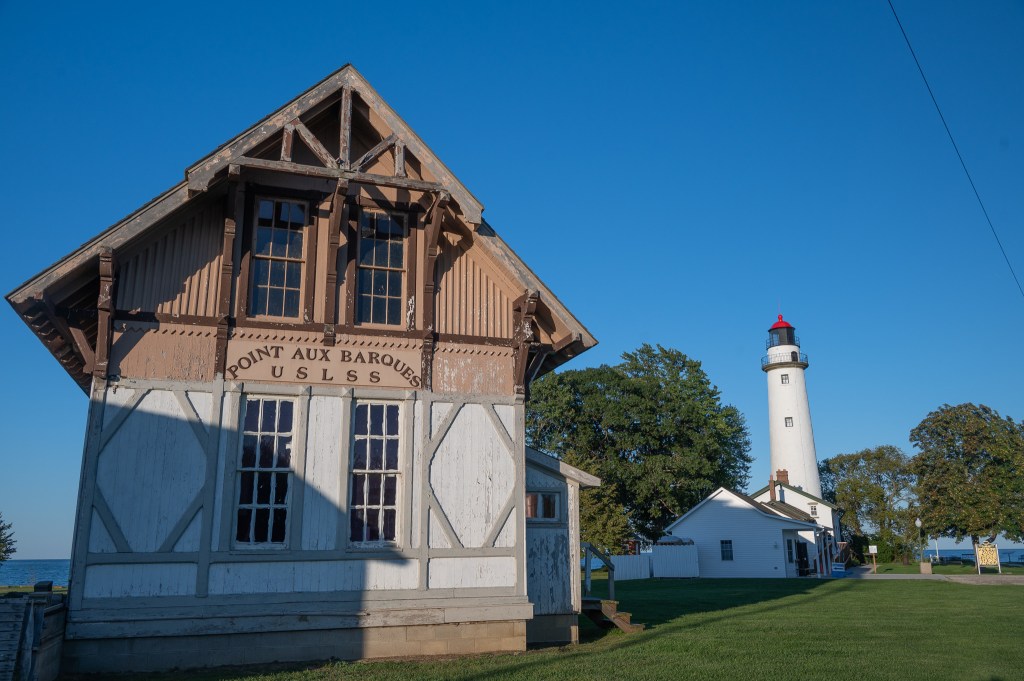
Once I set up camp at the Port Crescent State Park I meandered further up into the thumb until I arrived at Pointe aux Barques Lighthouse, a place Katie and I had visited a time or two in years past.
The original lighthouse was built in 1848. In 1857 this structure was built after a fire.
There’s a campground attached to the grounds that I hoped was empty. It wasn’t, but it wasn’t as full as it would be in the summer. So I wandered around the lighthouse grounds and then waited for the sky to get dark.
Lights from the campground and the light tower lit up the other buildings.
The Milky Way, up in the Southwest early in the evening this time of year, wasn’t in a position to be over the lighthouse, but it was above the other historical structures on the grounds.
Light and shadows interfering from every angle.
The challenge, as it always is with a lighthouse, was the bright light the tower itself was projecting. I tried to time my 15 second shot to be between the beams of light, but it was hard. Plus there was the campground, with it’s green lights and cars coming and going.
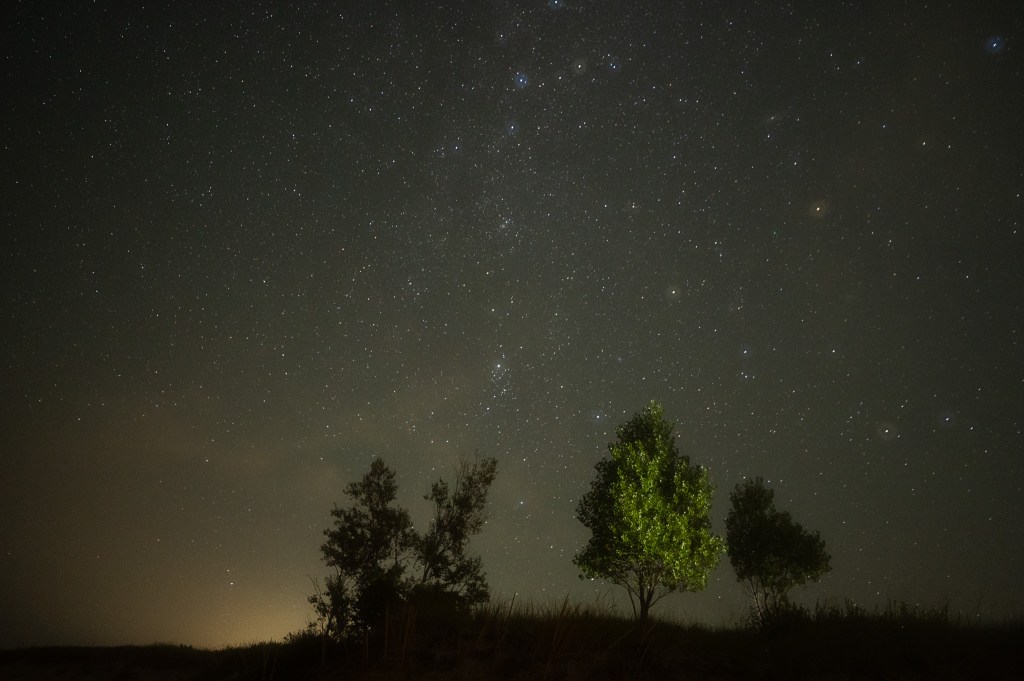
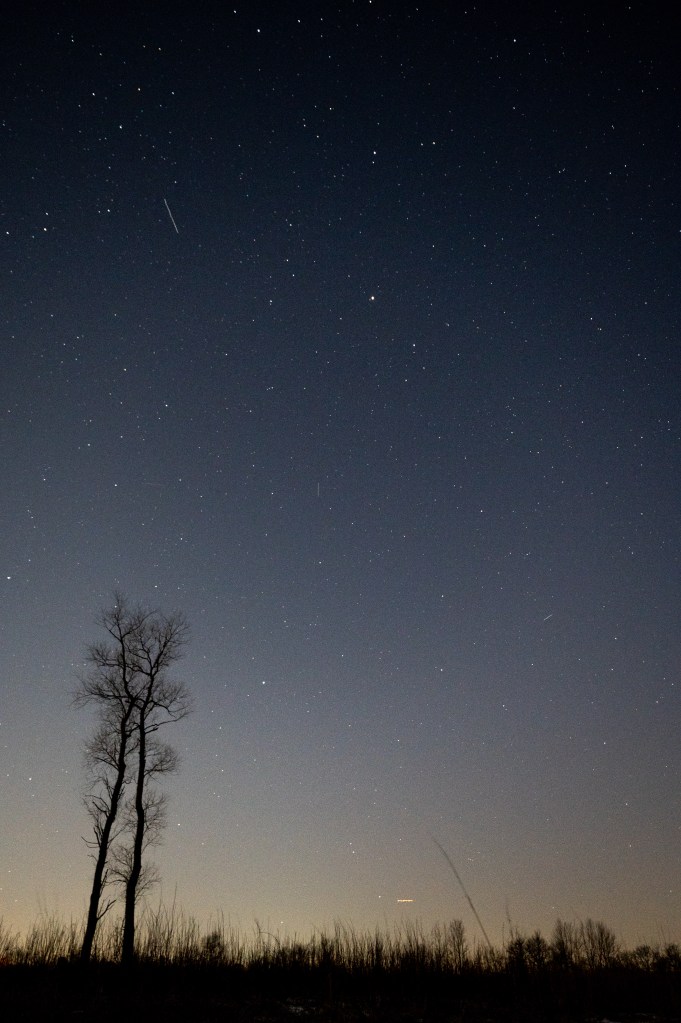
If you make this bigger you might see what might be a couple of meteors above and to the right of the tree.
So, once again, I wasn’t thrilled with the Milky Way images, but shooting out over Saginaw Bay was fun. There was a tree on the top of the bluff, and the Big Dipper was just above it. Though it’s hard to see the Big Dipper because the camera sees so many more stars than our eyes do.
This meteor was more pronounced.And you can see the Big Dipper in this, darker, version of the scene.
Regardless of the results, and as always, I loved being out there. The air was warm, the stars were bright, the moon had taken a nap, there were people nearby but not too close and I could hear the waves lapping at the bottom of the bluff.
A perfect place to sleep in late the next morning.
This might have been my last attempt for this Milky Way season. October won’t have many opportunities, and we’ll have to see what the weather does. I plan to spend the winter studying the information in my Milky Way Photography class.
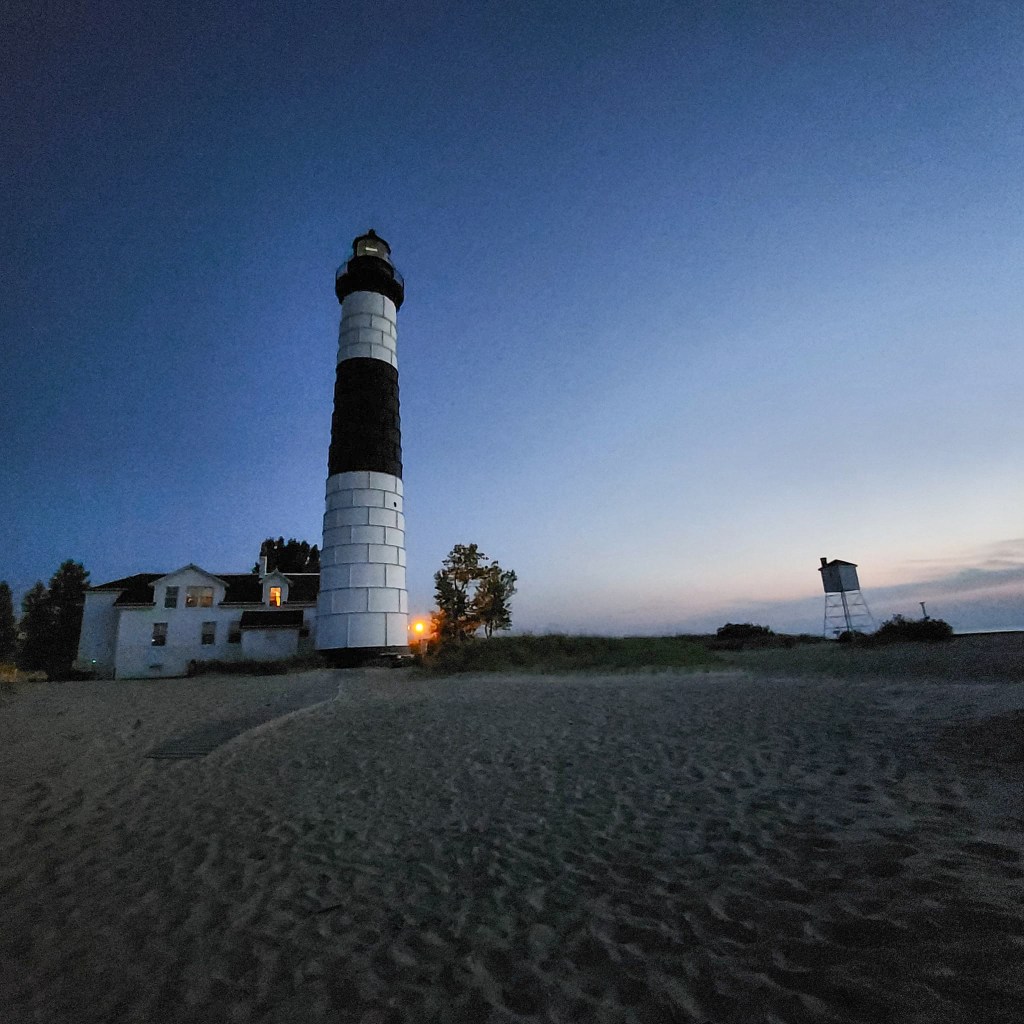
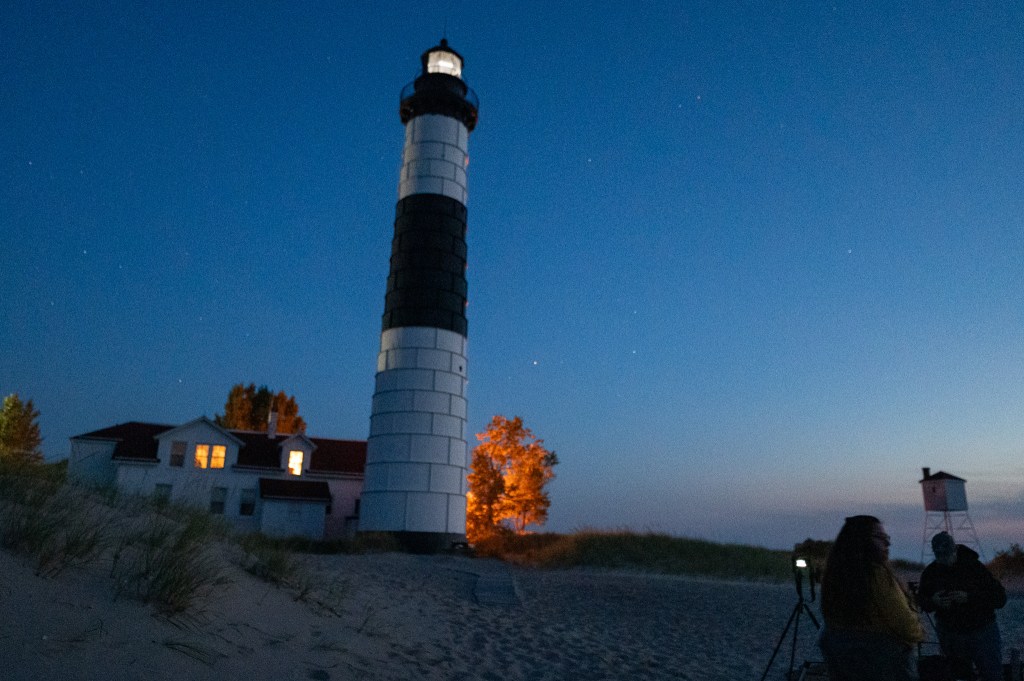
A few days ago 3 other intrepid women photographers and I ventured forth to a new destination, Big Sable Lighthouse, at Ludington State Park.
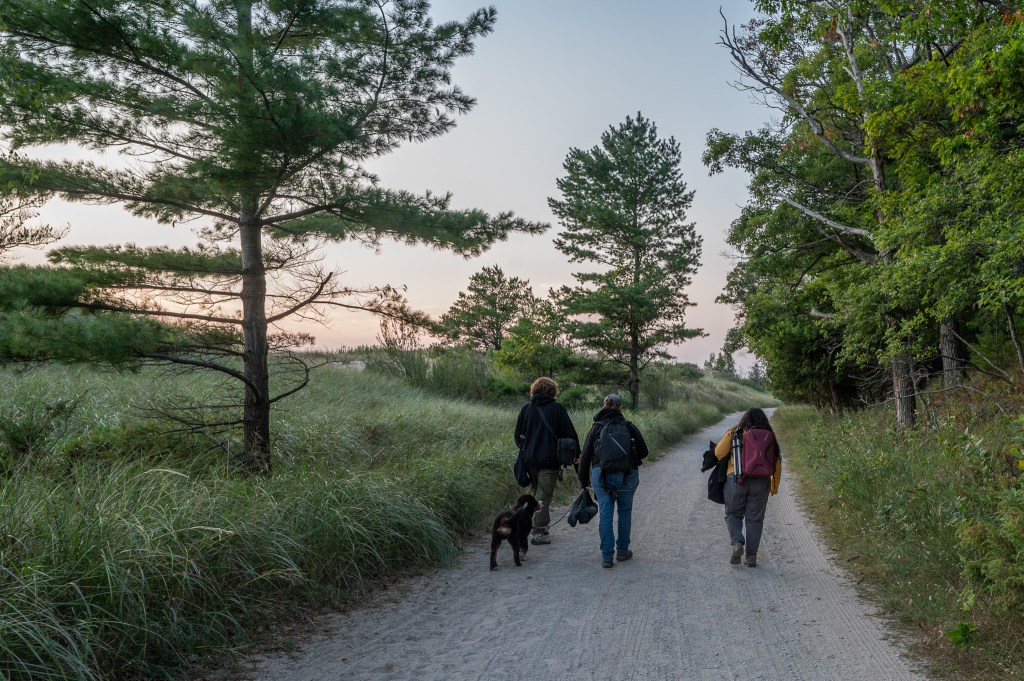
The four of us plus puppy Wally walked out to the beach as the sun set.
We were, of course, looking for a dark place to shoot the Milky Way. We are all members of an online Milky Way photography class, though most of us had never met in person.
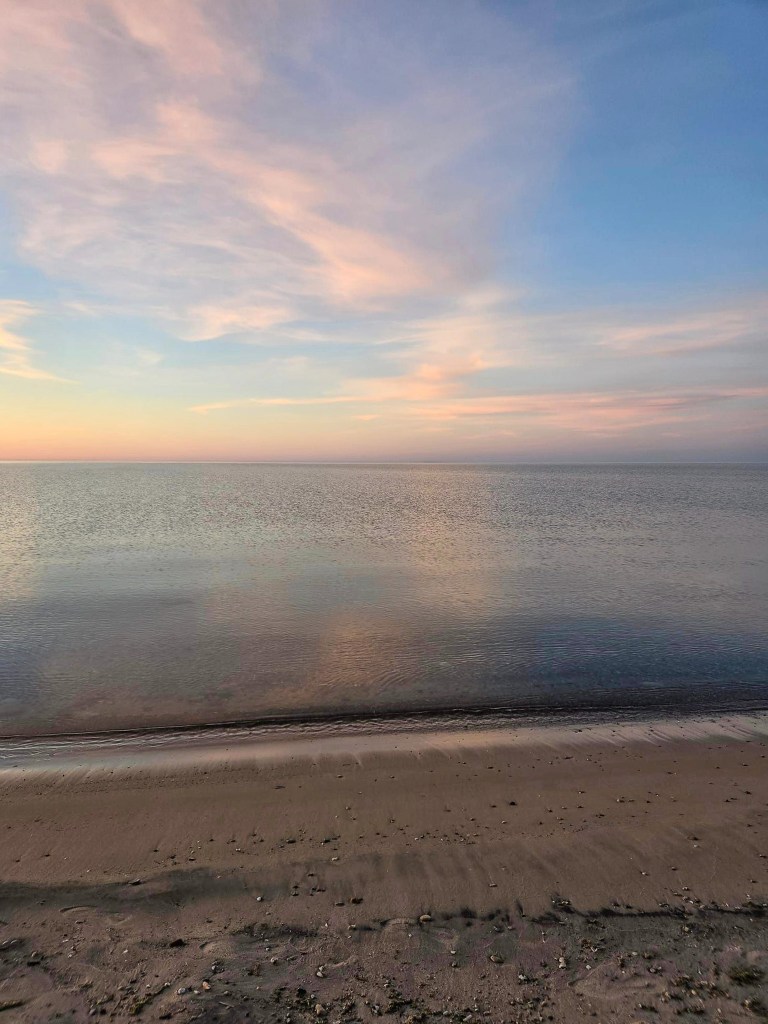
It was a beautiful pink and gold and navy evening.
We put this particular adventure together quickly, with a barrage of text messages flying between us, when we realized there was a clear night coming up. Then, the day before, someone did some research and messaged the group — “Do you know there’s a 2 mile walk out to the lighthouse?”
We’re headed up there.
Uhhhh, no, no we did not know that. This caused a bigger flurry of messaging and then someone finally just booked a campsite for us all at the park and we decided to go for it.
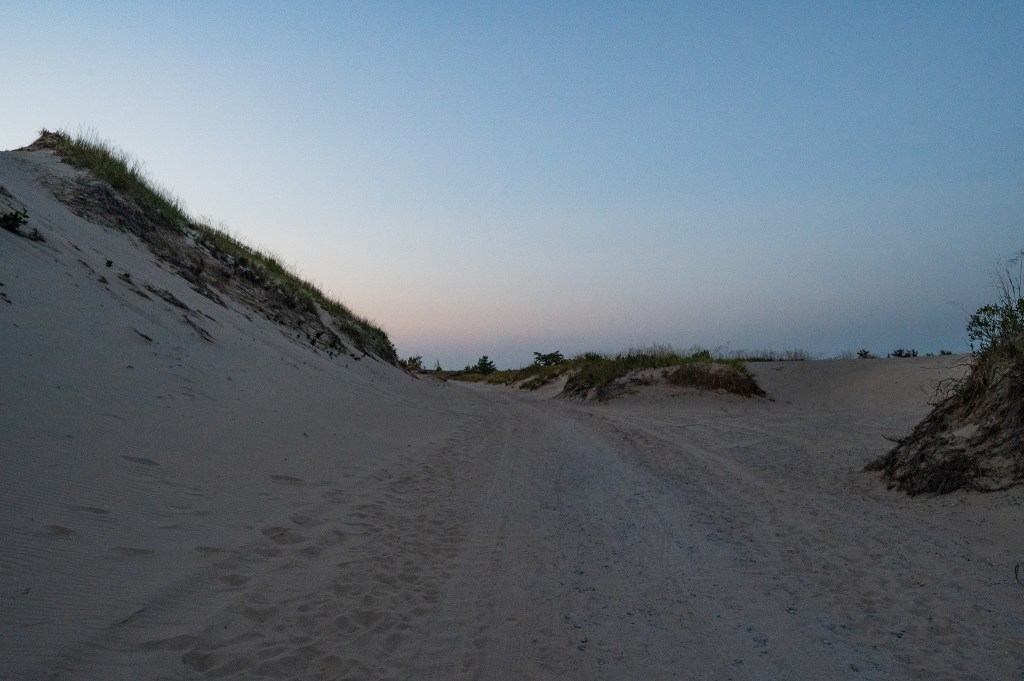
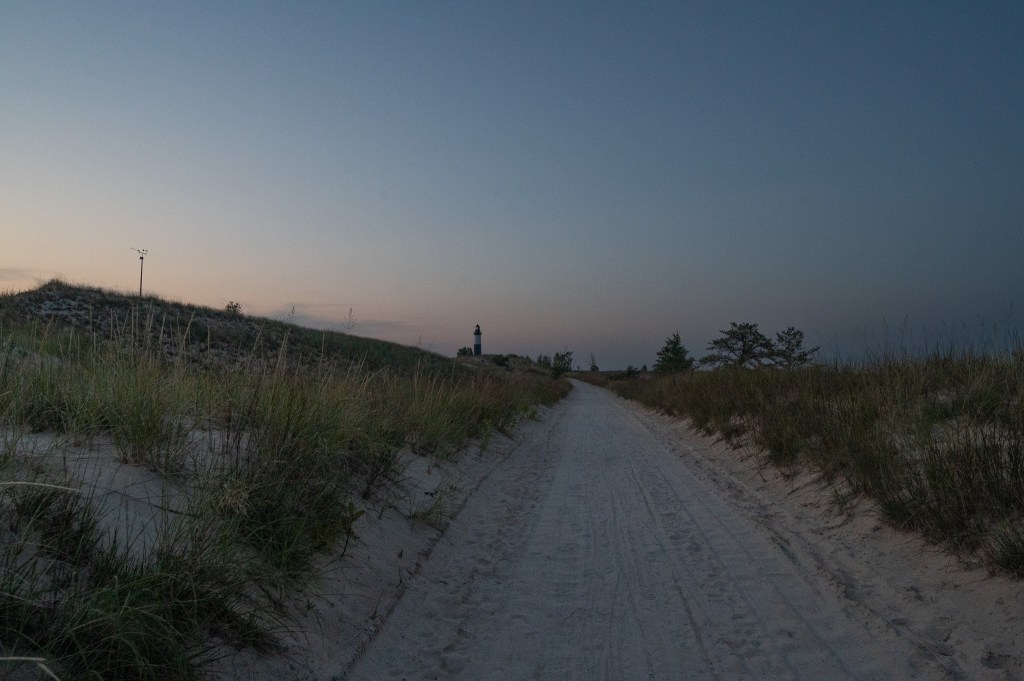
We had a beautiful night for our adventure, and the walk was shorter from the campground than from the lighthouse parking lot, only 1.5 miles through the woods and dunes. And of course 1.5 miles back in the dark, but underneath a star packed sky.
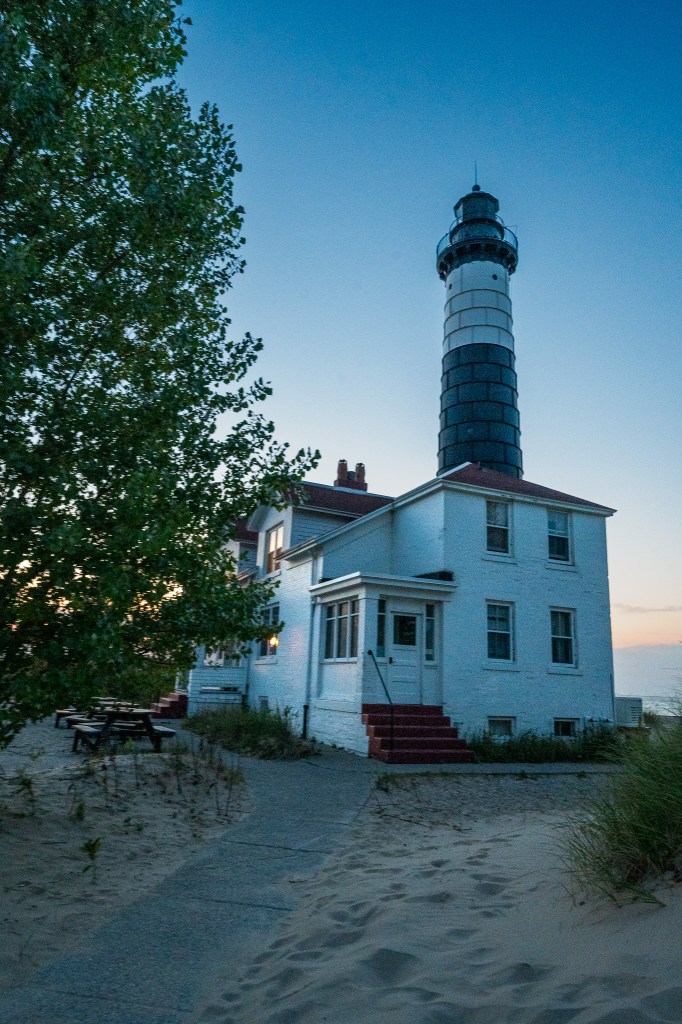
It’s a grand building, big enough to house 3 keeper’s families, back in the day.
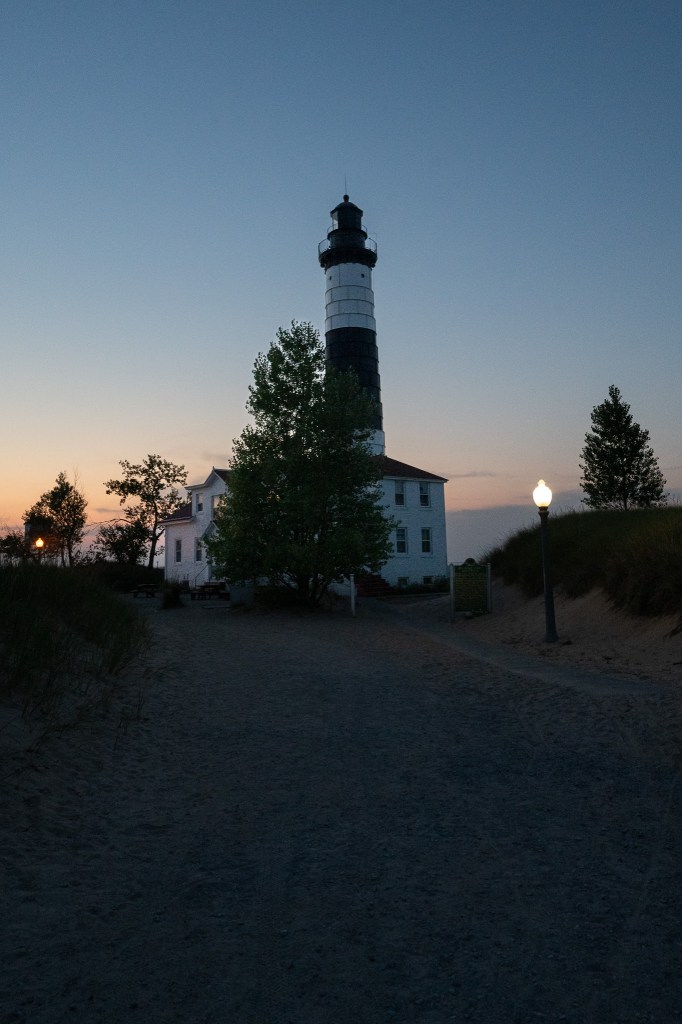
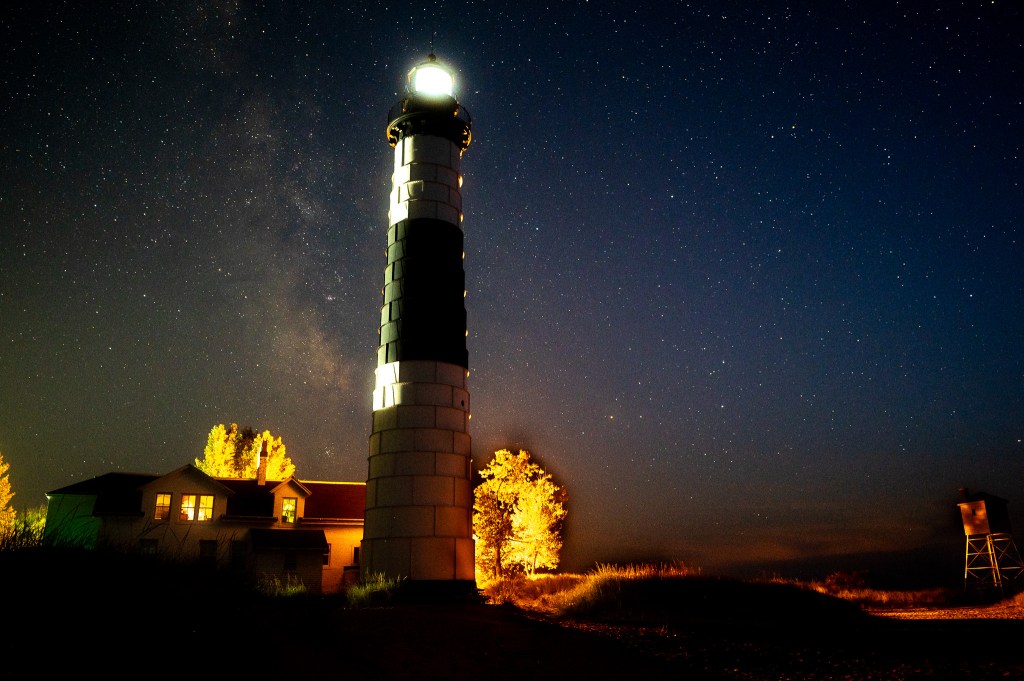
Our biggest obstacle turned out not to be the getting there but the lights that surround the lighthouse. There is a big streetlight shining in front, and an obnoxiously orange light in back making the whole back of the lighthouse and most of the grounds glow neon.
Our first glimpse of the challenges that would be presented.
According to our apps the Milky Way, now pretty vertical, would be right alongside the tower about 10 p.m. We were convinced it would be a stunning shot.
Taken with my cell as we waited for dark skies.
If it weren’t for the orange light…and that big tree.
It became obvious to us as we waited that we weren’t going to get that dream image.
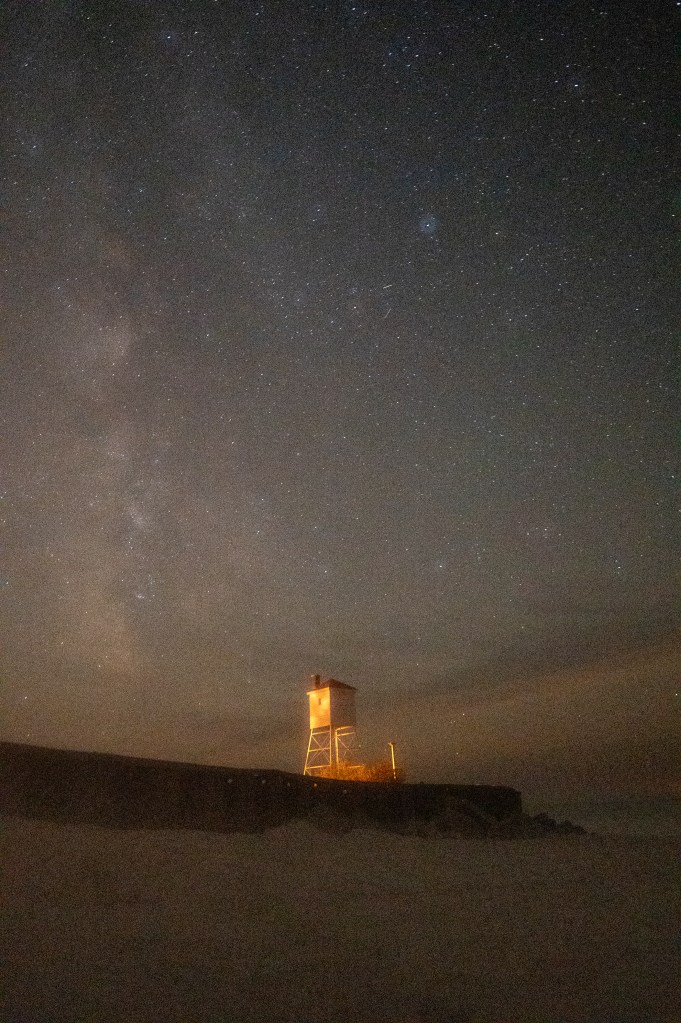
So we did the best we could with the lighthouse itself and then we spread out across the beach looking for other interesting things.
The Milky Way was up there, but faded out by all the light.
There was a gentle breeze sweeping away the bugs and the stars were hanging above us and no one was in any kind of hurry to leave.
Even down closer to the lakeshore the light was overpowering.
When we finally did begin to pack up around midnight I noticed my backpack was pretty wet from condensation. I began to realize the trouble I had had focusing on the stars, or anything for that matter, might have been because I had condensation on my lens.
I walked way out into the dunes and shot out over Lake Michigan. That’s a fishing boat down near the bottom left.
Condensation which would have been eliminated if I had put my lens heater on the camera at the start. The lens heater I bought the week before and lugged 1.5 miles out to the beach, but left in my backpack.
Sometimes you just have to go right up to your target.
Yep. One more lesson in a whole list of lessons I’ve learned on this Milky Way journey.
Another lesson – when you’re focused in one direction don’t forget to turn and look the other way once in awhile.
As a side note, there’s been quite a bit of death tangent to my life this past week. Not people directly tied to me, exactly, but people important to people important to me. I guess the heavens gained a few more stars.
A few more stars twinkle this week.
Late that night while listening to the lake murmur and wandering the dunes, watching the Milky Way slide across the sky I noted the newcomers.
And then we all walked back to camp under the umbrella of the starry night, content in our imperfect images, happy that we went, ready to do it again the next clear, moonless night.
After the bagpipe parade my sister and I began to prepare for a night trek through the cedar forest and along the sandy beach out to the end of Sunset Point. The wind was picking up and we were worried that waves we heard crashing somewhere out in the lake would be washing over the point.
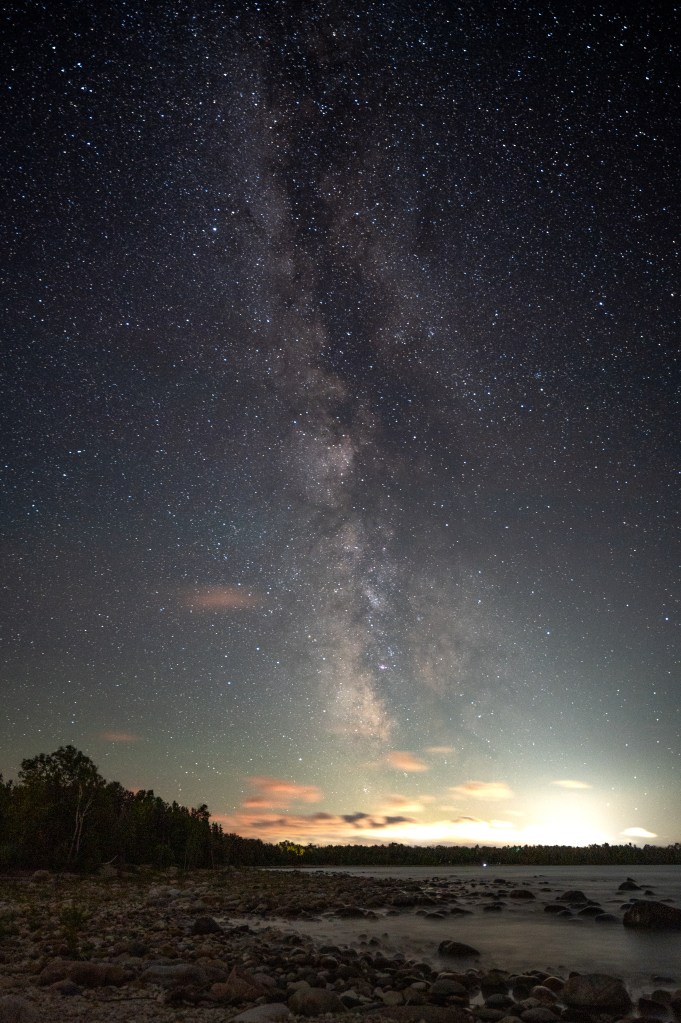
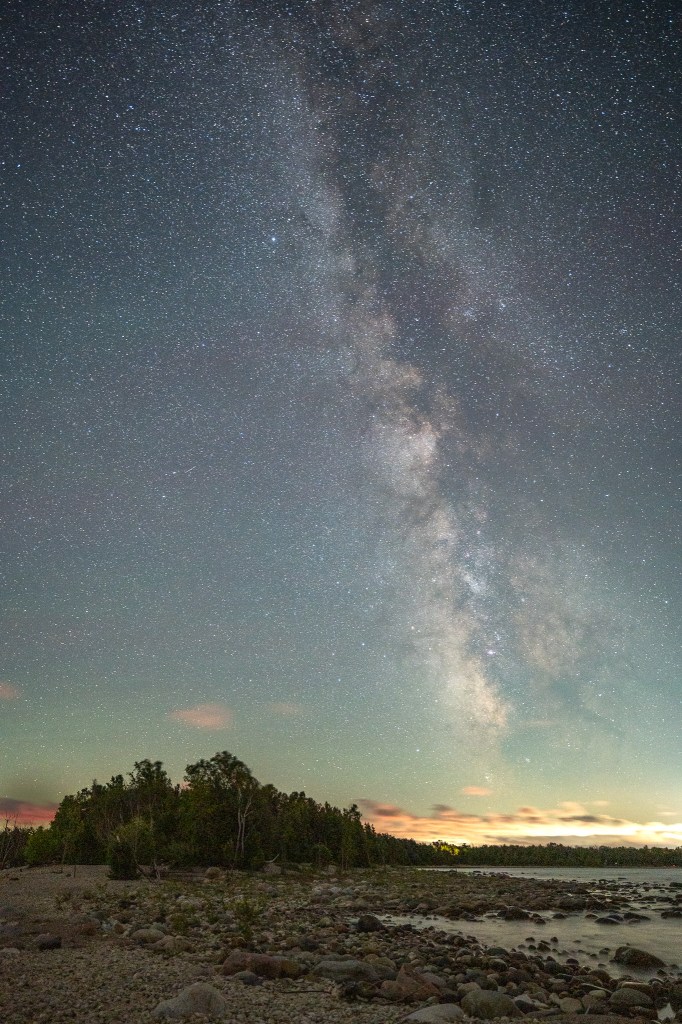
At 11 p.m. we decided to head out there and check it out for ourselves. There was a certain amount of anxiety as we wound our way through the woods and along the beach, but we were relieved to find there were no waves anywhere near the point and we were able to set up on a picnic table out on the point with a perfect view of both the Milky Way to the southwest and the Big Dipper to the north.
I lightened these somewhat for Facebook, but you’ll still want to look at them in a dark room if you can, and on a larger screen.
My first composition included more of the water in the bay. The light on shore is someone with a flashlight, probably also out looking at the meteor shower.
She sat in a chair and watched the northern sky, exclaiming in excitment every time she saw a meteor streak across the sky. I focused on the Milky Way, deciding to include some of the bay in my first set of images, and then moving slightly to the left to include all the trees in the next series of shots.
I like this composition too, with more of the trees we walked through to get out to the point included.
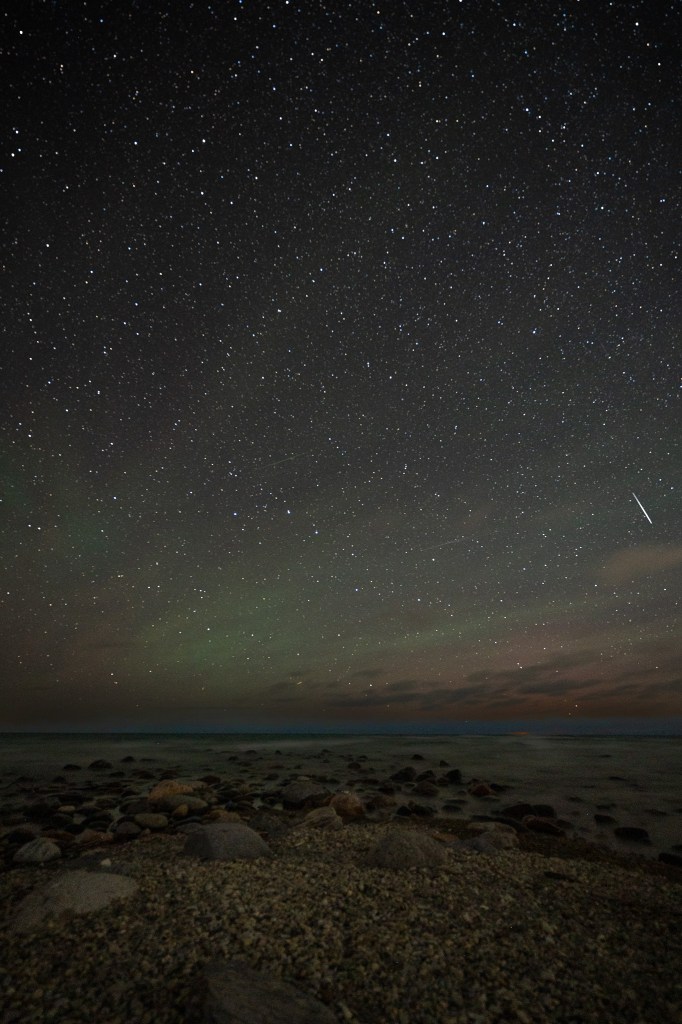
But she was seeing so many streaking meteors that I decided to turn my camera around and see what happened. I liked the rocky point jutting out into the dark lake.
I was lucky enough to get the meteor in the shot – barely.
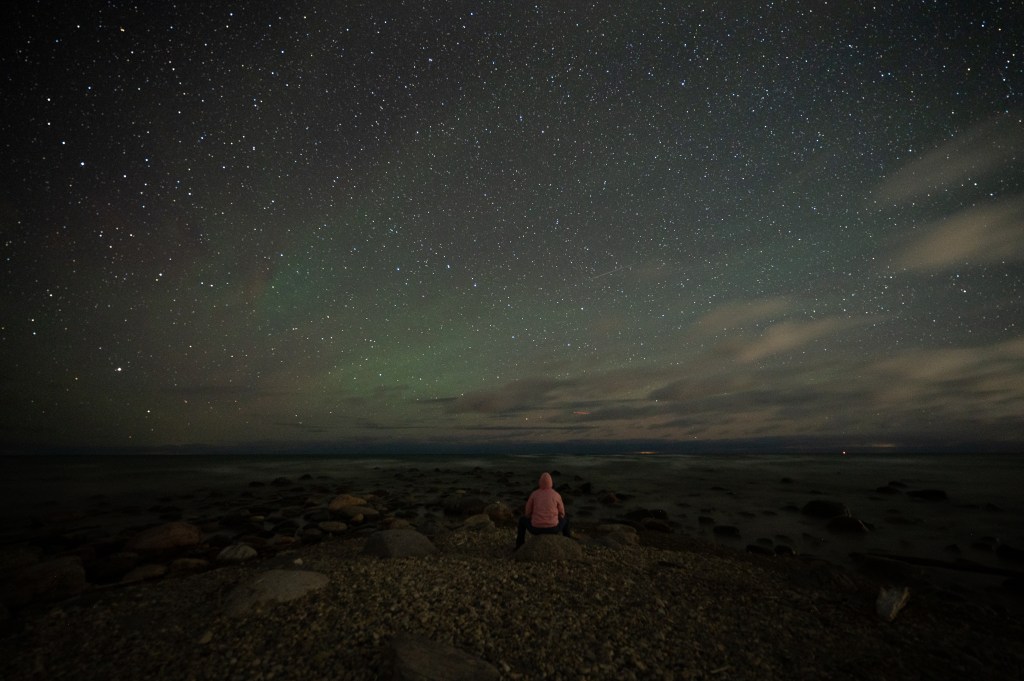
And then I asked her to go sit on a rock at the edge of the gravel, still many yards away from the water, and sit very still for 20 seconds while I took a shot of her watching the sky.
The green might be air glow, or it might be northern lights. There was some pink in the sky too.
I love this shot so much. The image looks peaceful, but in actuality the wind and wave noise was so loud I had to signal when the shot was finished by flashing a light at her.
Then we realized I could set up the camera and she could push the remote shutter release while I sat on the rock watching the sky.
Such a perfect place to star gaze.
This was sooooo cool, to sit out at the end of a rocky peninsula and look at the stars. In this image I think there are 3 meteors, though at the time I didn’t see any of them.
My sister had been watching part of the Milky Way which was directly overhead and she asked if I’d take a picture of that, so I pointed the camera straight up and pressed the shutter release.
Uh oh, clouds have invaded.
But when we looked at what we had we realized the clouds had suddenly moved in. Our night of shooting stars was over. Our window of opportunity had been less than 2 hours. I was very glad we went out there a bit earlier than we had planned. I was happy with what we had captured and we hoofed it back down the point, across the beach and through the woods to our waiting car.
Back in camp, snug in my tent, I scrolled through my images on the back of my camera. I couldn’t see much detail in the small screen, but I knew it was there. I was smiling so big it was hard to go to sleep.
During our exploration walk out to the point earlier in the day.
I don’t know if I would have gone out that night, given the roar of the lake and the gusty wind, if my sister hadn’t been with me. Thanks to her we had a magical couple of hours, and now you get to share in it too!
So what does a person do all day while waiting for true dark to arrive? Besides nap that is.
Working on the river.
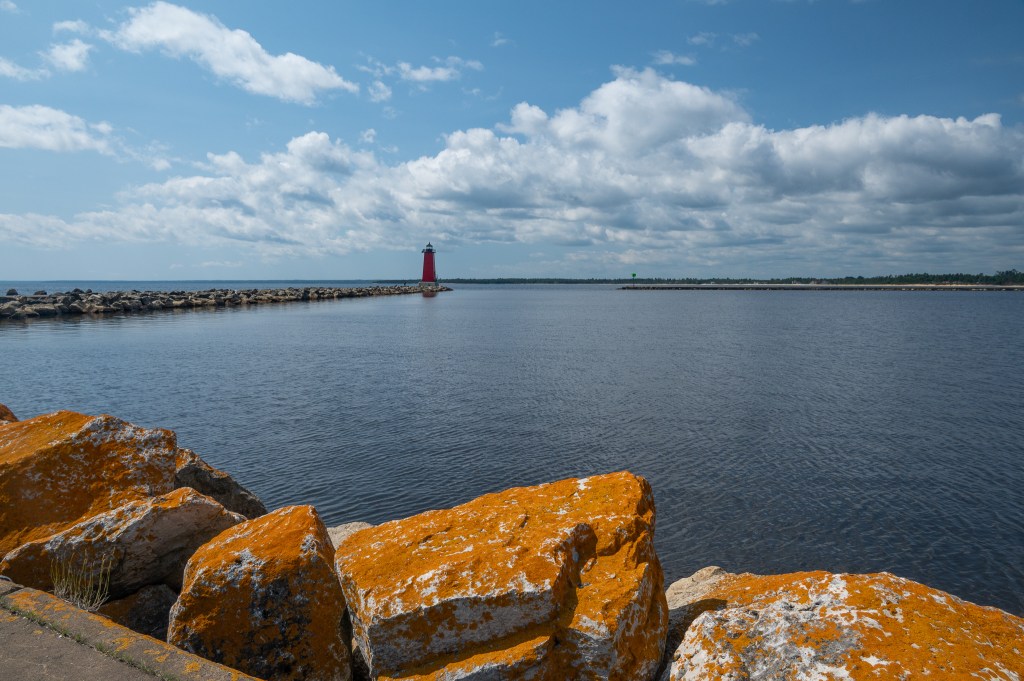
Well, on the one day the skies were clear while I was in the UP I wandered the Manistique waterfront looking for other things to photograph while impatiently urging the sun to hurry up and sink.
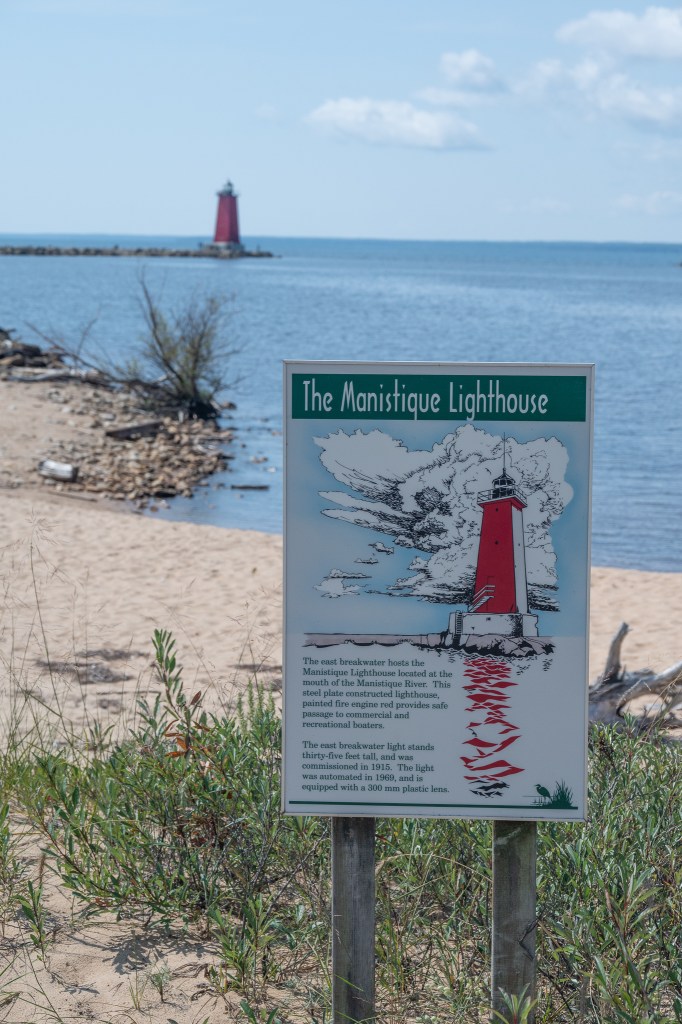
If you zoom in you might be able to read about the lighthouse.
The mouth of the Manistique River was being dredged so I watched that for awhile. It was sort of interesting, but you can only watch so many piles of mud being moved before you have to move on.
Scoop after scoop of muck was dug up from the river bottom and poured into the barge.
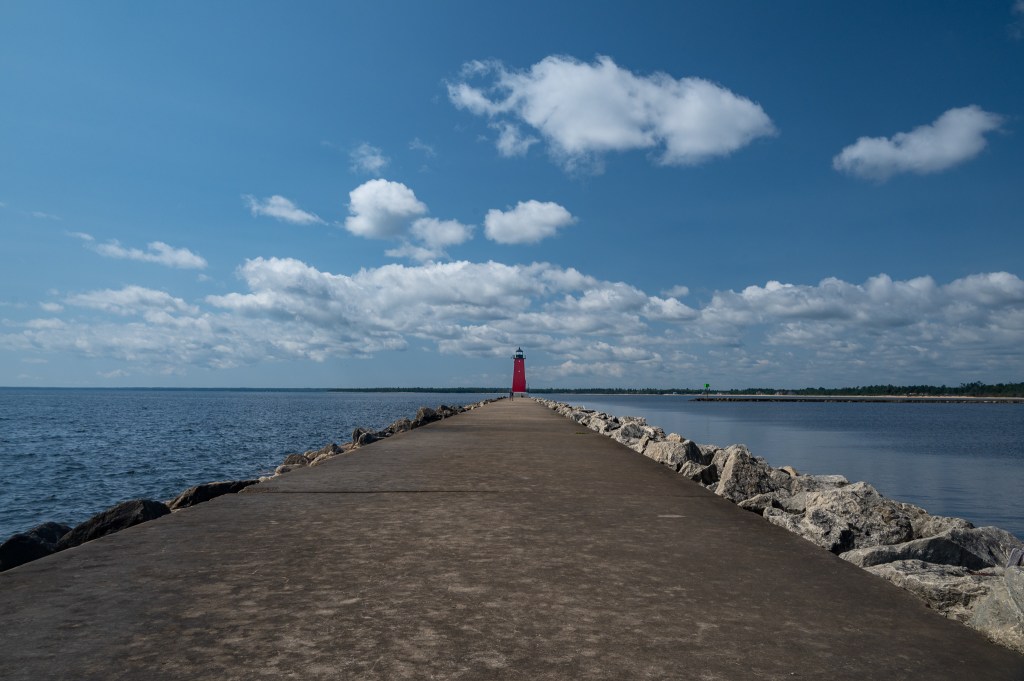
I couldn’t resist walking out on the causeway leading to the shiny red lighthouse. It was such a pretty day.
A wide cement walkway made the trip out there easy to navigate.
I spent quite a bit of time out there waiting for the sun to go down. And watching the light glint off the water.
It’s not a long walk on a pretty day.
A couple of guys were fishing but they hid behind the lighthouse for me to get some shots.
All metal, it can withstand some nasty weather. But none was forecast while I was there.
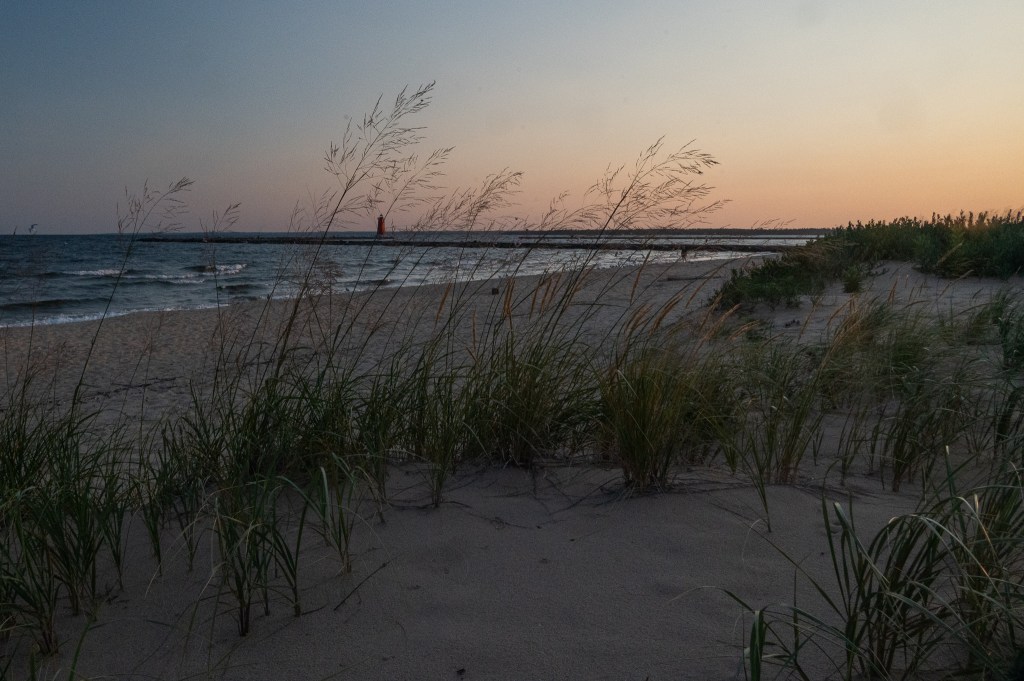
But as the sun lowered I came back into shore.
The flowers glowed, loosestrife, an invasive, and goldenrod.
The evening light makes everything so pretty.
The last bit of light before the magic begins.
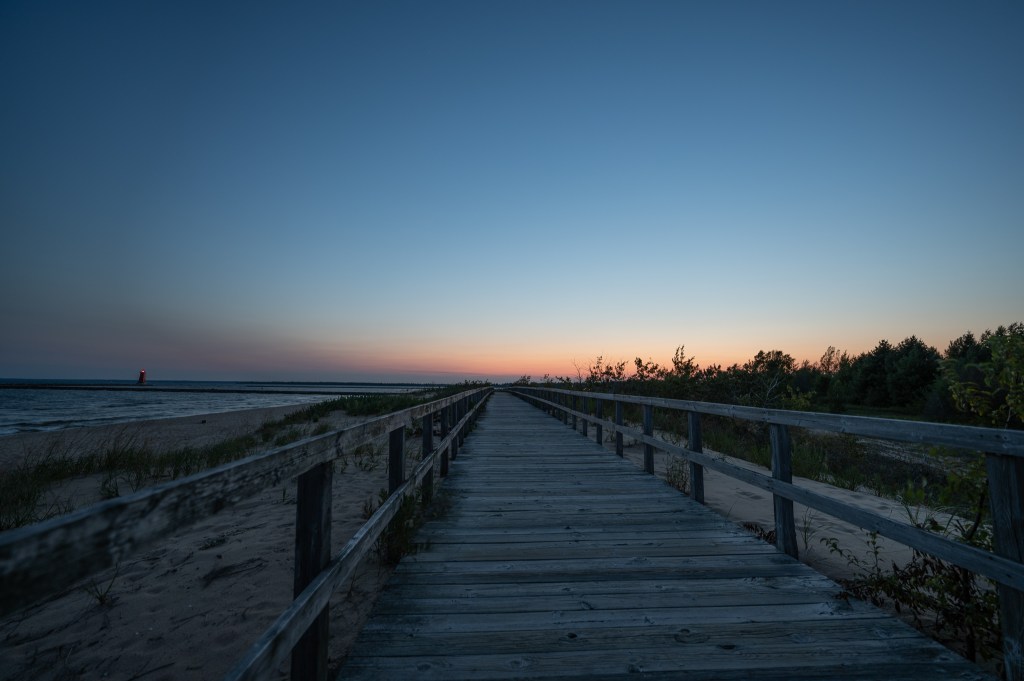
And then, slowly, slowly, the sun sank and the blue hour began.
Let’s take a walk down this boardwalk.
Earlier in the day I had scoped out a place to set up, hoping that the Milky Way would be near the lighthouse from my vantage point. The compass said it should be. But I knew I only had one night so I hoped I wasn’t wrong.
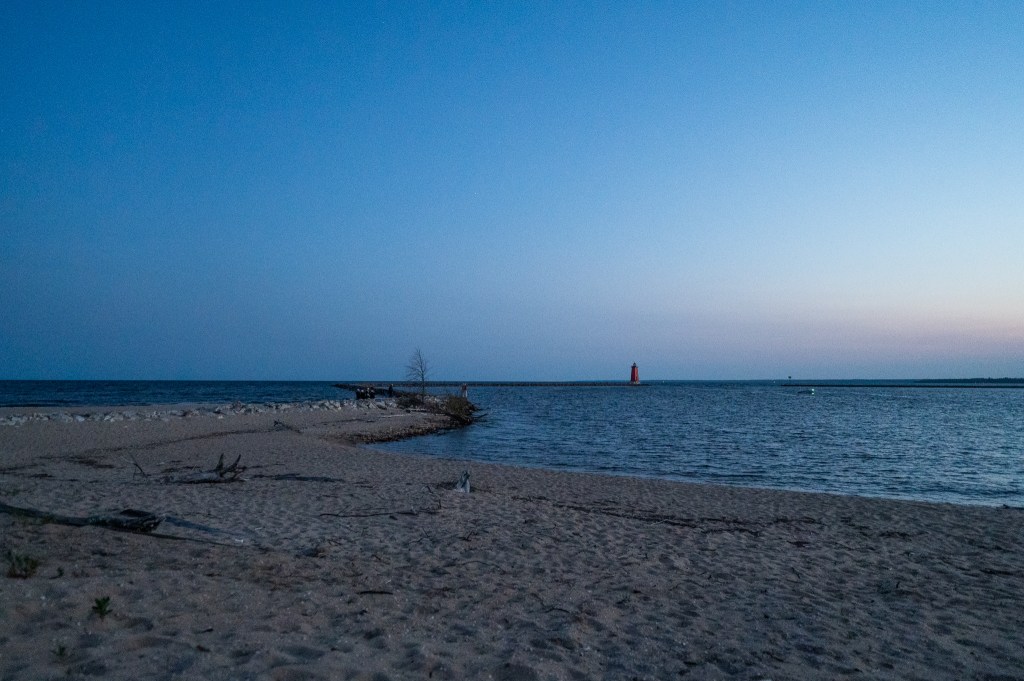
The beginning of blue hour on the beach.
I waited impatiently. It takes forever for the night to get truly dark. And then….a few stars decide to turn on their lights.
Here we go…
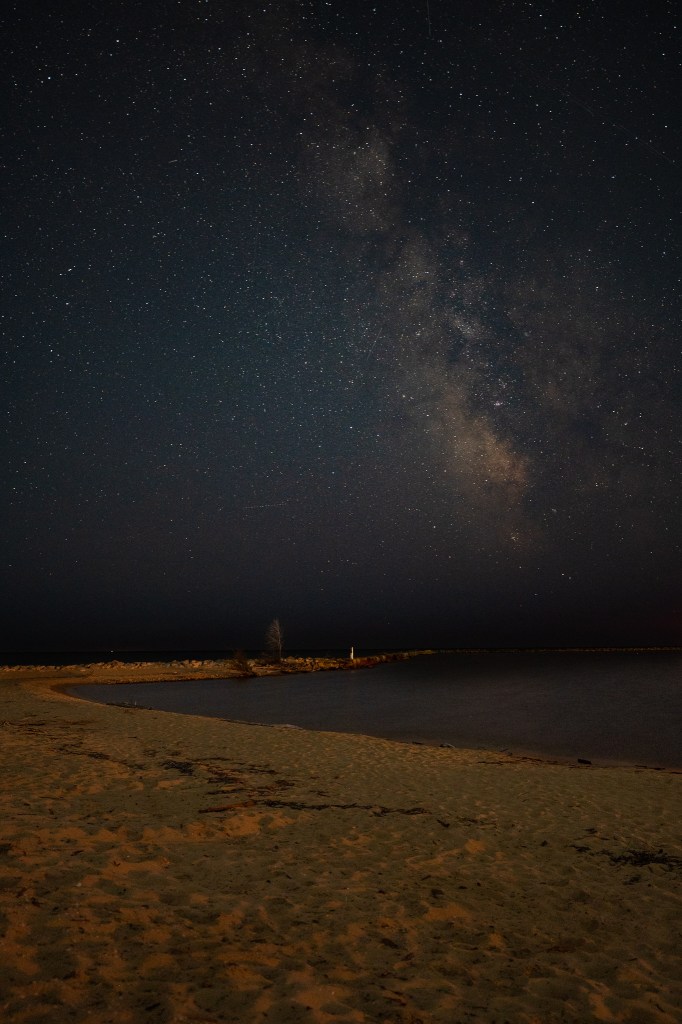
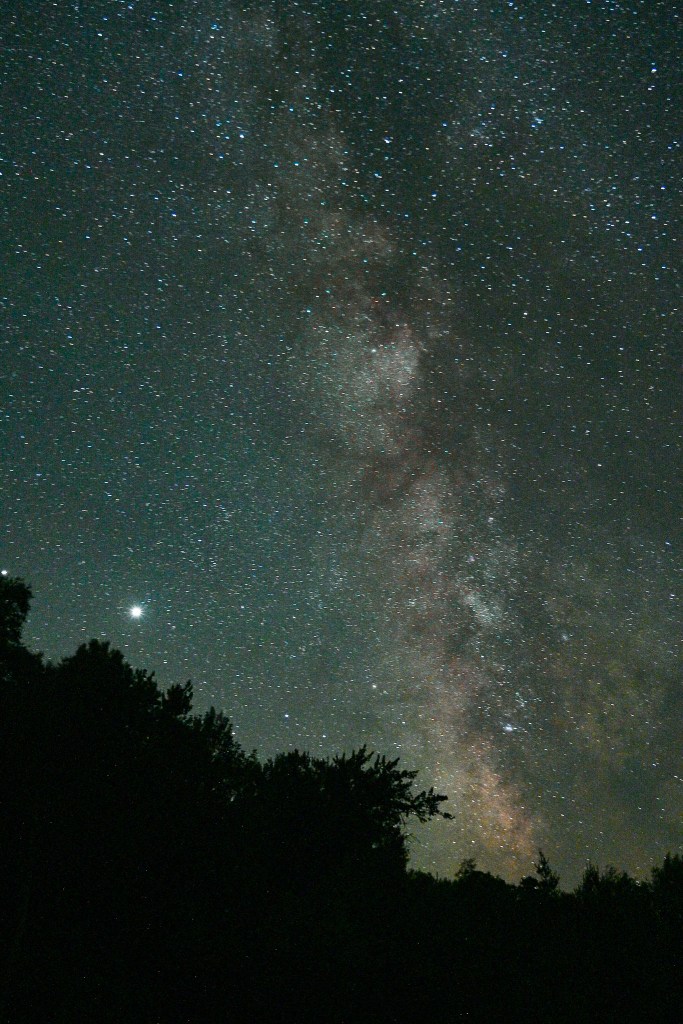
I still couldn’t tell exactly where the Milky Way was going to shine…but the stars made me smile anyway. And then….finally, finally, there it was. It was pretty darn amazing. I don’t know why the beach wasn’t full of people just staring.
Take a moment and just look.
I stayed out there a long time. A lot of it not shooting, just standing there, in the moment.
Because, really, how many shots can you take of the same lighthouse with the Milky Way? Well, as it turns out…several dozen. You see, the dark sky requires that you have a high ISO and a wide open aperture and that causes grainy shots.
Beautiful without the lighthouse too.
But you can stack them. Did you know that? There’s software that will lay your photos, one on top of the other, and match up your stars and eliminate anything different. And that clears up a lot of the grainy noise. Huh. So I was taking 7 shots of each shot, in preparation for stacking. But I learned, just this week, I should have taken 10 to 15 shots to stack.
Ah well.
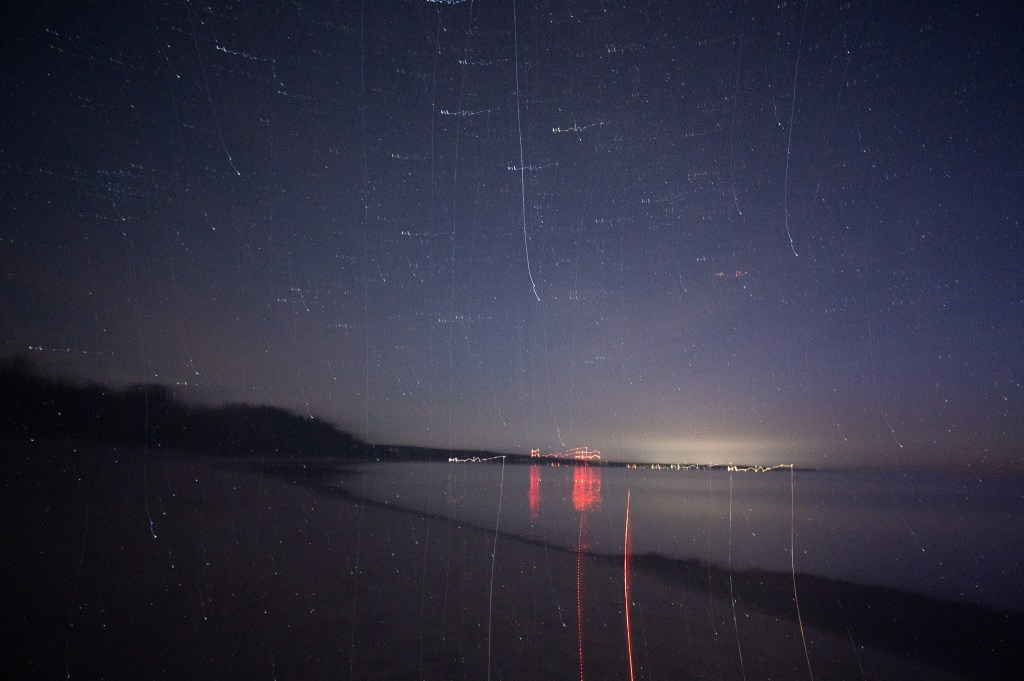
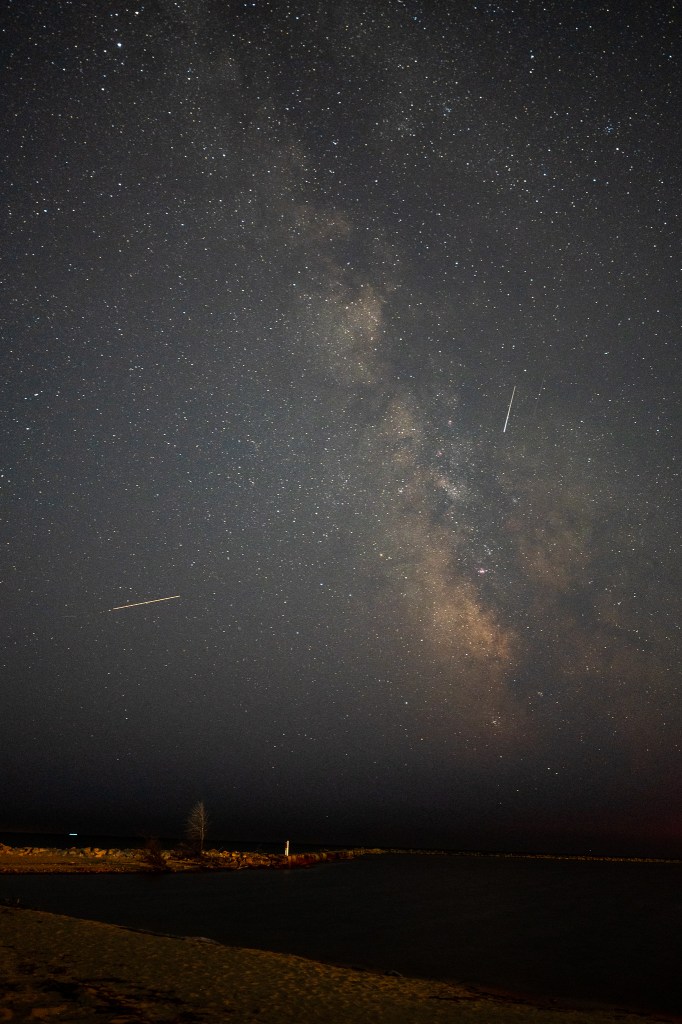
Many of my images had these streaks. I never saw it when I was on the beach, but some people say this light in the sky is the Sky-Link satellites.Zoom in and see what you think.
So, anyway, these are single images, no stacking here, just a little editing to bring out the whites and sometimes to lift the shadows.
I still have so much to learn…so many technical things that I can do to make the images more clear, more beautiful. But the Milky Way season here in Michigan is almost over. There will be one more chance in October, just a few nights, and then I’ll have to be patient until 2023.
Just to show you, we are never alone, the sky is full of stuff flying around.
Yea right. I can hardly handle waiting for the sun to set in a single evening. How am I going to get through months of no Milky Way?
I’m taking a Milky Way photography course on-line. It’s consumed a lot of my time, as there is so much to learn. I’ve been working on improving my night photography skills since 2017 when I took a one evening class. Too bad that one night there was sleet and rain, but I learned a lot.
And now I’m learning more. I went out a couple weeks ago to a local park, in the middle of the night, just to practice my settings and see how it felt to be out there in the dark again.
It felt pretty wonderful, but that was a park close to home. We have lots and lots of light around here, and I’m going to have to go further afield to find darker skies. Still, it’s good to practice.
I need to go out again soon and practice some techniques for getting the stars in focus. But it’s raining and it’s going to keep raining…maybe right through the next new moon window of opportunity for Milky Way shooting!
So, out of frustration I went back to some images I took in the summer of 2020 when the comet was flying high and I was standing on a sandy bluff overlooking Lake Michigan. Once the comet was done for the night I turned around and saw the Milky Way.
Tonight I wistfully clicked through those pictures. They sure aren’t perfect, but they remind me of a wonderful time. But I hope to do a much better job of focusing on my next attempt!
Now if it would just stop raining.
Be warned, those of you that live in dark areas of the country, eventually you’re going to hear from me, asking to camp out in your backyard. I promise to be quiet as I skulk around under your sky.
You might even want to join me. You’d be amazed at how time flies when you’re standing in the dark looking up at millions of light years looking back at you.















 Change Is Hard